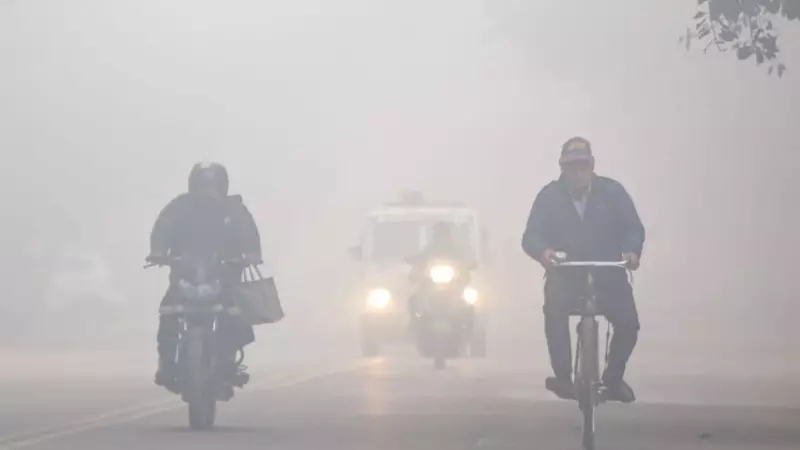
Delhi's Air Quality Slips Back to 'Poor' Category After Brief Respite
After experiencing two days of slight improvement, Delhi's air quality has once again deteriorated to the 'Poor' category. On Monday, the city recorded an Air Quality Index (AQI) of 241, marking a significant drop from the 153 registered on Sunday, which fell under the 'Moderate' category.
Neighboring Cities Also Witness Air Quality Decline
The decline in air quality was not limited to Delhi alone. Noida saw its AQI worsen from 120 on Sunday to 219 on Monday, while Gurugram experienced a similar trend with AQI rising from 198 to 276 during the same period. According to Central Pollution Control Board (CPCB) standards, an AQI between 201 and 300 is classified as 'Poor', indicating potential health risks for sensitive groups.
Weather Forecast: Rain Today, Foggy Week Ahead
The India Meteorological Department (IMD) has issued a yellow alert for Delhi, predicting one or two spells of light rain on Tuesday. While this rainfall is expected to provide temporary relief by improving air quality through windy conditions, the city is set to return to its familiar winter grey soon after.

According to the IMD bulletin, shallow to moderate fog during morning hours is expected from January 28 onward. With another fresh Western Disturbance slated to affect Northwest India on January 30, clear and sunny skies are unlikely to return to the capital anytime soon.
Air Quality Outlook and Temperature Predictions
The Indian Institute of Tropical Meteorology (IITM) forecasts that Delhi's air quality is likely to remain in the 'Moderate' category on January 27 and 28 before deteriorating to 'Poor' on January 29. The outlook for the subsequent six days also indicates that air quality is expected to stay in the 'Poor' category.
Meanwhile, the incoming cloud cover will influence temperatures throughout the week. The IMD forecasts minimum temperatures to hover between 8°C and 10°C for most of the coming week, which is close to the long-term average of 8.4°C for this time of year. On January 28, the minimum temperature could rise to 11–13°C, slightly above normal.
However, any relief from the cold will be offset by chilly daytime conditions. Cloud cover and wet spells are expected to suppress daytime temperatures, with maximum temperatures likely to remain at 17–19°C, below the seasonal normal for the next seven days.
Current Weather Conditions and Meteorological Factors
On Monday, Delhi recorded a maximum temperature of 23.2°C at Safdarjung, while the minimum settled at 4.2°C, more than four degrees below normal. Ayanagar remained the coldest pocket in the city, recording a low of 3.6°C.
The current weather shift is being driven by a Western Disturbance seen as a trough in the middle and upper tropospheric westerlies, along with an induced cyclonic circulation persisting over Haryana and its neighboring areas.
Windy conditions with gusts reaching 30–40 kmph are expected during early morning and forenoon hours on Tuesday, which should help improve air quality temporarily. Additional spells of rain are likely to extend from afternoon into the night.