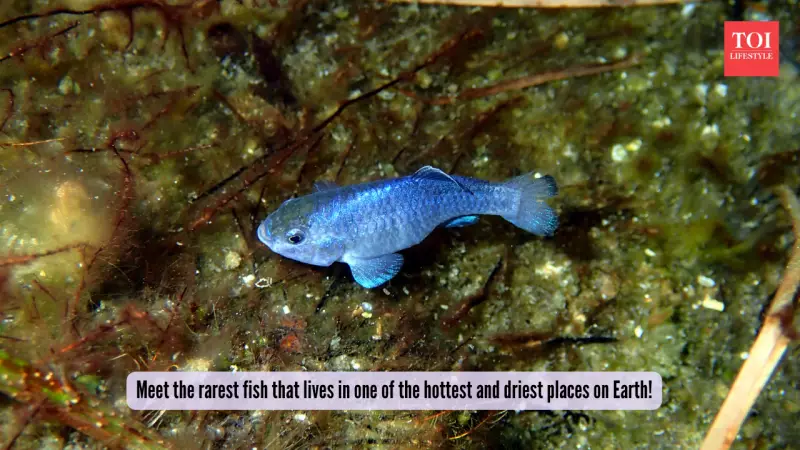
The Devils Hole Pupfish: A Tiny Titan in Death Valley's Furnace
Nature holds countless secrets, with many species still waiting for discovery. One of its most astonishing wonders hides in plain sight within the brutal landscape of Death Valley. Here, against all logic, life not only exists but persists in a place where survival seems impossible.
A Cave of Extreme Survival
Deep in Nevada, part of the greater Death Valley region, lies Devils Hole. This is not your ordinary cave. It measures roughly 22 meters long and 3.5 meters wide, but it plunges to a depth of nearly 150 meters. Within this geological formation, in just the top 15 to 24 meters of water, lives the entire global population of the Devils Hole pupfish.
This makes their home the smallest known habitat for any vertebrate on Earth. The water maintains a constant, bath-like temperature of 33°C and contains very little oxygen. The fish rely on a shallow rocky shelf within the cave to feed on the algae that grows there.

Precarious Existence on the Edge
The population of these inch-long fish tells a dramatic story of boom and bust. In the spring of 2024, biologists counted around 191 individuals, marking the highest number seen in a quarter-century. This hopeful trend was brutally reversed in 2025.
A series of earthquakes disrupted the delicate ecosystem of Devils Hole. The tremors affected the algae, the pupfish's primary food source, and also destroyed many of their eggs. By 2025, the population had catastrophically crashed to just 38 fish.
This species lives a short life, typically between 10 to 14 months. They spawn throughout the year, with their numbers usually peaking in the spring and fall seasons. However, the survival rate of their eggs is naturally very low, keeping their overall numbers perpetually precarious.
A Swift Rescue Mission
Facing this emergency, wildlife biologists did not stand by. They immediately activated a pre-existing preparedness plan. Their actions were decisive and swift. They released captive-bred pupfish into Devils Hole to bolster the wild population. Simultaneously, they provided supplemental food to help the fish survive while the natural algae recovered from the earthquake damage.
Devils Hole is located within the Ash Meadows National Wildlife Refuge. The area has faced other threats, including destructive flash floods. These proactive conservation interventions have been crucial in managing immediate risks to the fish. Yet, challenges remain. Natural predators, like diving beetles, continue to pose a constant threat to the already tiny population.
An Ancient Mystery of Isolation
How did these fish end up in such an isolated, extreme place? Scientists have proposed several theories. One prominent study suggests the pupfish have been trapped in Devils Hole for an astonishing 60,000 years, ever since the cavern first formed. Other theories propose a more recent isolation, perhaps just thousands of years ago, possibly via underground water flows or even carried by birds.
The fish themselves show unique evolutionary adaptations. They lack pelvic fins, a trait they share with and likely inherited from their ancestor, C. nevadensis. While they do not share a direct lineage with human evolution, the pupfish stand as a powerful testament to the adaptability of vertebrate life, tracing back to fish ancestors millions of years in the past.
The story of the Devils Hole pupfish is more than a wildlife report. It is a profound lesson in resilience. In one of the hottest, driest places on the planet, in a patch of water no bigger than a small room, these fish endure. They face brutal heat, low oxygen, earthquakes, and the ever-present shadow of extinction. Yet, they persist, a global symbol of life's stubborn will to survive against the greatest odds.