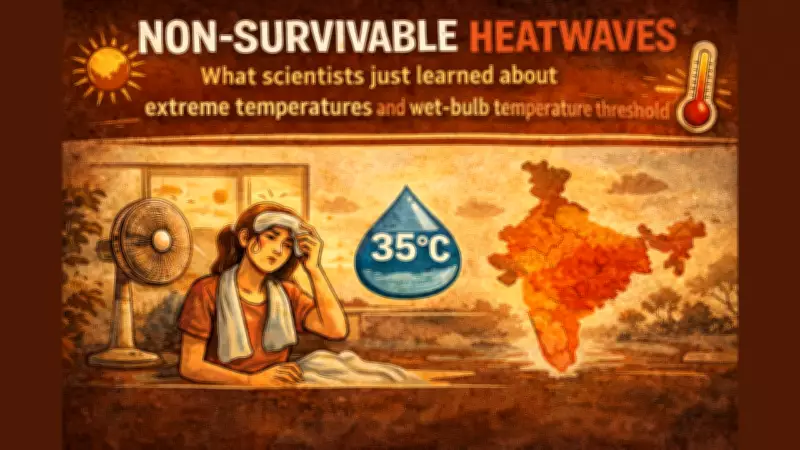
New Study Overturns Long-Standard for Deadly Heat Survival Limits
For years, the rule for deadly heat seemed straightforward: when the wet-bulb temperature reaches 35°C, humans cannot survive. This threshold has been the scientific standard used globally to assess extreme heat risks. However, groundbreaking new research has fundamentally challenged this number, revealing that lethal conditions may occur at significantly lower temperatures than previously believed.
HEAT-Lim Model Reveals Alarming New Thresholds
A team of researchers has developed a sophisticated physiology-based model called HEAT-Lim that demonstrates environmental heat stress thresholds may be both cooler and drier than scientists have assumed. The implications are profound—if we have been using incorrect temperature benchmarks as danger markers, we have likely been underestimating serious health risks for decades.
The researchers conducted a comprehensive analysis of six historical heat events where conditions were exceptionally extreme or resulted in significant mortality. Their findings, published in the prestigious journal Nature Communications, reveal that non-survivable conditions are already occurring during present-day heat events, all of which fall below the 35°C wet-bulb temperature threshold.

Understanding Wet-Bulb Temperature and Its Critical Importance
What exactly is wet-bulb temperature? This measurement combines temperature and humidity to assess how effectively the human body can cool itself through sweating. When humidity is low, sweat evaporates easily, allowing the body to maintain a safe temperature. When humidity is high, sweat evaporation becomes inefficient, causing the body to struggle with heat dissipation.
The traditional 35°C wet-bulb threshold has been considered the critical survival limit where sweating becomes completely ineffective, the body can no longer lose heat, and core temperature rises dangerously even during rest in shaded conditions with access to water.
Six-Hour Exposure: The Critical Timeframe
The researchers emphasize that the six-hour exposure period is crucial for understanding heat mortality. When individuals are exposed to these extreme conditions for approximately six hours, their bodies are likely to overheat to dangerous or fatal levels, even without engaging in physical activity. This timeframe represents the window during which the body's cooling mechanisms become overwhelmed.
Older Adults Face Disproportionate Risk
The study reveals particularly alarming findings regarding vulnerable populations. Older adults face the greatest risk from these newly identified lethal heat conditions. The researchers found that deadly thresholds were regularly exceeded for older people directly exposed across all analyzed heat events.
This increased vulnerability stems from natural physiological changes that occur with aging. Older individuals experience diminished temperature regulation capabilities, including reduced sweating efficiency and compromised blood flow to the skin—both critical mechanisms for cooling the body during heat exposure.
Dry Heat Presents Equal Danger to Humid Conditions
One of the most significant revelations from this research challenges conventional wisdom about heat dangers. Extremely hot yet dry conditions have been found to be just as deadly as hot and humid environments. This discovery dramatically expands our understanding of global heat risks.
In humid conditions, the primary danger comes from inefficient sweat evaporation leading to rising body temperatures. In dry conditions, the risk shifts to rapid dehydration as the body loses water through excessive sweating before individuals recognize their escalating heat stress. A dry 50°C day in regions like the Middle East or Central Asia can prove just as lethal as a humid 35°C day in South Asia or Southeast Asia.
Implications for Public Health and Emergency Planning
The researchers stress that increasingly accurate physiology-derived methods are essential for properly assessing heat risks in our warming world. Misunderstanding when conditions become deadly has serious consequences—potentially inadequate public warnings, insufficient cooling center availability, and flawed emergency response planning.

The uncomfortable reality emerging from this research is clear: deadly heat conditions are already occurring at temperatures lower than previously recognized, and the most vulnerable populations—particularly older adults who may lack access to cooling resources—are already experiencing fatal consequences.
As scientific understanding advances, the critical question remains whether policymakers, public health officials, and communities will adapt their approaches to reflect these new, more accurate thresholds for human survivability in extreme heat.