

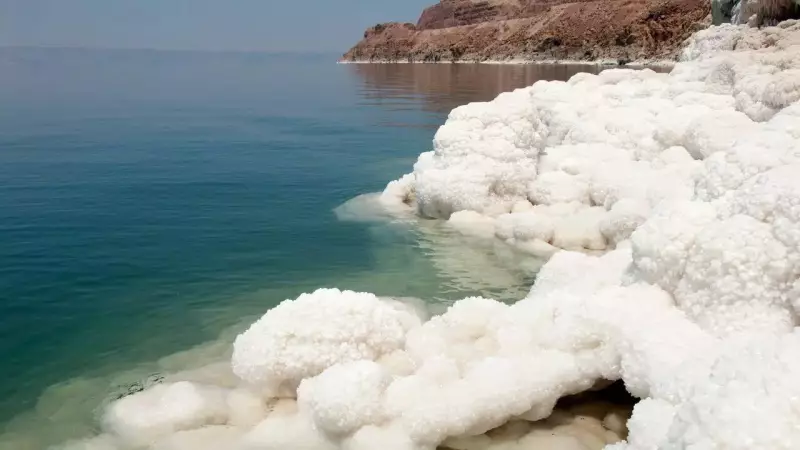
Dead Sea's Future: A Gradual Shrinkage, Not Sudden Disappearance
The future of the Dead Sea looks quieter than many alarming warnings once suggested. New long-term modeling indicates the lake will become smaller, warmer, and more saline over time. However, it will not vanish suddenly. This research paints a picture of slow, persistent change rather than dramatic collapse.
Modeling Reveals a Slow Decline
The study treats the Dead Sea as a closed system where water, heat, and salt constantly interact. Evaporation here behaves differently than in freshwater lakes. As water evaporates, salt remains behind. This shift alters how the brine functions. Heat moves in unique ways, and evaporation actually slows down rather than speeding up.
These complex feedback mechanisms are hard to isolate individually. Yet together, they shape the lake's evolution over generations, not within a single lifetime.

Testing the Model Against Historical Data
To validate their model, researchers ran simulations covering the period from 1928 to 2022. The simulated lake levels closely matched recorded measurements, including the steady decline observed in recent decades. Temperatures in the upper mixed layer also aligned well with instrument and satellite data.
While the match was not perfect, it provided enough confidence to project future trends. The study, titled "The future fate of the Dead Sea: Total disappearance or a dwarfed hypersaline hot lake?", relied on detailed bathymetric data. As the lake shrinks, its changing shape becomes increasingly important.
The Long-Term Transformation
Under scenarios with limited freshwater inflow and continued industrial brine extraction, the lake continues losing water for centuries rather than decades. However, the rate of loss is not constant. As salinity increases, evaporation becomes less efficient. Water loss continues but slows down, restrained by the lake's own chemistry.
Over hundreds of years, the lake approaches a loose balance. Evaporation, atmospheric conditions, and remaining inflows begin to offset each other. This state is not fixed or sharply defined but represents a gradual stabilization.
A Smaller, Hotter Lake Emerges
The long-term outlook reveals a lake occupying less space and retaining heat more effectively. With reduced volume and higher salinity, temperatures rise and remain elevated. The brine behaves differently, with reduced activity affecting how heat and moisture move across the surface.
Researchers describe this outcome as a "dwarfed hypersaline hot lake." It still exists but differs significantly from the Dead Sea of the past. Even compared to today's shrinking shoreline, the future version appears altered, quieter, and more constrained.
Key Factors Influencing the Future
Freshwater inflow remains crucial in shaping every outcome. Small changes in water supply create noticeable differences over long periods. Regional warming and drying trends add pressure, pushing the lake further along its transformation path.
Industrial withdrawals also matter, particularly in the nearer term. However, their influence blends into broader environmental forces over centuries. Earlier studies reached different conclusions largely due to varying assumptions. This new work combines physical modeling with analytical checks to narrow the range of possibilities without claiming absolute certainty.
No Sudden Collapse in Sight
The findings do not support predictions of an abrupt collapse. Instead, they point to a drawn-out transformation guided more by slow physical processes than sudden tipping points. The decline remains serious but appears persistent rather than terminal.
Uncertainty persists due to climate variability, human decisions, and complex thermodynamic behavior. What emerges clearly is not a specific endpoint but a direction of travel. The Dead Sea continues changing gradually and will likely keep doing so well beyond our current time.






