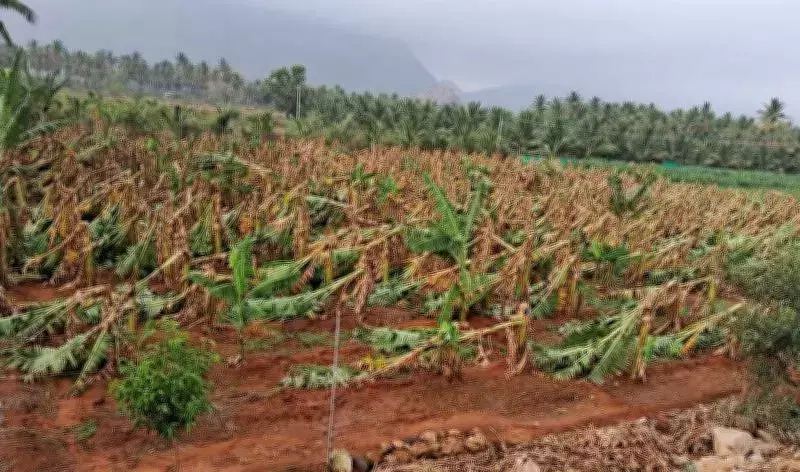
Coimbatore Hailstorm Shatters Farmers' Hopes, Crops Destroyed
A devastating hailstorm has shattered the hopes of farmers in Coimbatore district, particularly in areas like Annur, Saravanampatti, and Sulur, who had been anticipating rich yields after months of hard work. Most of their crops, which were ready for harvest, have now been completely destroyed. The plight extends to farmers in Ooty and Coonoor in the Nilgiris district, as well as Punjai Puliampatti in Erode district, where similar devastation has been reported.
Unprecedented Hailstorm in Western Tamil Nadu
Farmers report that the western region of Tamil Nadu has not experienced a hailstorm of this magnitude in the past two decades. This event marks the first hailstorm to hit the western districts in six years, lasting for three consecutive days from March 17 to 19. In the Annur area alone, around 15,000 acres of farmland have been damaged. One farmer shared, "Most of the banana plantations ready for harvest were destroyed. The last hailstorm was five to six years ago, but there was no crop damage. This time, ice pellets remained on farmlands for more than a day, which is unusual. My family cultivated banana, watermelon, and coconut, all in the harvest stage. We expected high returns due to summer demand, but everything is lost."
Official Inspection and Damage Assessment
Coimbatore district joint director of agriculture, M Thamilselvi, along with scientists from Tamil Nadu Agricultural University (TNAU), inspected the affected villages in Annur taluk on Friday. Thamilselvi stated that such intensive crop damage from a hailstorm has not been reported in the district in the past 20 years. The damage is concentrated in three villages within the Annur block: Chengapalli, Aambothi, and Kanavukkarai. Horticultural crops like banana and tomato have been primarily affected. Damage assessment is currently underway, with a report to be submitted to the district collector on Saturday.

Scientific Insights and Climate Change Link
G Dheebakaran, associate professor at the Agro Climate Research Centre, TNAU, noted that ice pellets did not melt for over 38 hours in the region, a rare phenomenon as they typically melt within three to four hours after rainfall. He explained, "Hailstones form where precipitation occurs from more than five to six kilometres above the atmosphere in a cold cloud. Based on the torn leaves and crop damage intensity, it's presumed the hail's distance exceeded the usual, reaching a super cool stage. Also, hail is common in wet conditions, but this occurred in a very dry situation."
Dr N K Sathyamoorthi, professor and head of the Agro Climate Research Centre, TNAU, and Dr V Geethalakshmi, an expert in agricultural meteorology, attributed this condition to possible climate change. Sathyamoorthi said, "Though not fully attributable to climate change, the frequency of such events is definitely related. Hailstorms are usually reported in southern Tamil Nadu and rarely in western parts once every four or five years before summer." Geethalakshmi added that hailstones form due to a sudden temperature rise, causing immediate convection that lifts humidity into extremely cold, high-altitude regions. "For every 1km upward movement of airmass, the temperature drops by 6.5°C, forming ice pellets. The force and distance of their fall damage crops and properties like glasshouses."
Broader Impact Across India
Similar hailstorms were reported across other regions of India, including Karnataka, Andhra Pradesh, Jammu and Kashmir, Himachal Pradesh, Uttarakhand, and Darjeeling on March 15 and 16, highlighting a wider pattern of extreme weather events.