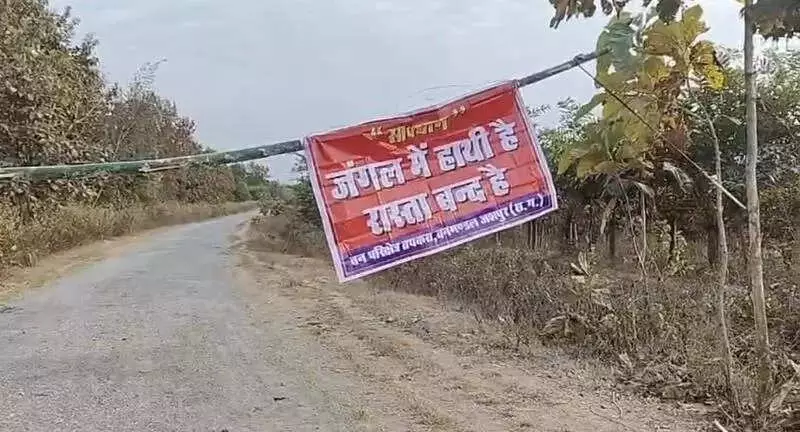
Chhattisgarh Forest Roads Become No-Go Zones as Elephant Herd Roams Free
Evening descends over Chhattisgarh's Jashpur district. Roads that usually bustle with workers heading to markets and children returning from school fall eerily silent. Barriers drop at 4 pm sharp. Vehicles disappear completely. Villagers now walk home on foot, glancing nervously at the shadows where more than forty wild elephants move through the darkness.
Forest Department Takes Drastic Action
The state forest department made a critical decision. They shut down all vehicle movement on the Tapkara forest range. This ten-kilometer stretch cuts right through the dense Satpuriya jungle. Officials took this step after a large elephant herd and a marauding lone tusker turned Jashpur's forest villages and highways into what they call a 'zone of concern'.
The move followed a terrifying incident last Saturday evening. Residents Bablu Nagvanshi and Rajkumar Nagvanshi were traveling with their families along the Satpuriya road. They were on their way to distribute condolence letters. Suddenly, the elephant herd appeared right in front of them.

The herd charged towards the men. Bablu scrambled up a tree to save himself. Rajkumar turned and ran back towards the village as fast as he could. From his precarious perch, Bablu called Rajkumar. He said he was stuck in the middle of the forest with the dangerous herd still circling below.
A forest rescue team led by guard Nandkumar Yadav rushed to the spot immediately. They conducted a careful operation and managed to bring Bablu down safely. This close call prompted immediate action from authorities.
Four-Pronged Strategy to Prevent Tragedy
Jashpur District Forest Officer Shashi Kumar explained the situation to reporters. 'With the sizable elephant herd prowling the region over the last twenty days, and a series of close shaves reported, we had to implement a four-prompt strategy', he stated. One key part of this strategy involved sealing the road with barriers to prevent local movement temporarily.
'Blocking the way is a temporary and preventive arrangement', the DFO clarified. 'We mainly do this on village routes that have easy alternative paths. We remove the barrier as soon as elephants move to a different location. This four-prompt strategy has proven impactful in Jashpur. The district has recorded minimum incidents of human-elephant conflict in 2025 compared to previous years.'
The forest department detailed their comprehensive approach:
- WhatsApp Alerts: The 'Gaj Soochna Kendra' sends regular updates about elephant movements and locations through voice notes on WhatsApp groups.
- Rapid Response Teams: Special teams quickly shift people living in vulnerable hamlets or forest fringes to safe camping places to prevent casualties.
- Warning Posters: Authorities place red 'no entry' posters on interior roads where elephants are moving. They remove these warnings within hours or a couple of days.
- Swift Compensation: The department ensures compensation for loss of life, crops, or houses gets processed within fifteen days.
Daily Life Disrupted for Villagers
Officials believe the elephants entered from neighboring Odisha. They have effectively taken over the Patebahal–Jamtoli Chowk stretch. This ten-kilometer road runs entirely through dense forest.
Nandkumar Yadav heads the elephant safety campaign in Tapkara. He described another recent rescue operation. 'Just two days earlier, my team spent hours rescuing two motorbike riders who found themselves surrounded by elephants on the Tapkara main road', he recalled.
'With three separate herds in Tapkara and Farsabhahar, we had no option but to shut the Ganjiyadih–Kolhenjharia main road', Yadav explained. 'From 4 pm till morning, vehicle movement is strictly banned to avoid any loss of life.'
Across the division, key roads and forest routes now feature barriers and warning boards. Strict advisories ask people to remain constantly alert to elephant presence.

To reach Jamtoli Chowk from Patebahal, villagers must take much longer, circuitous routes via Jorandazharia. In the Satpuriya belt, three families whose homes were destroyed in elephant attacks continue living in partially collapsed structures covered with plastic sheets.
Their houses have been reduced to rubble. Food stocks have depleted completely. They now face the peak winter months without secure roofs over their heads or adequate ration supplies.
Elephants Find New Home in Satpuriya
Forest officials say the Satpuriya herd has 'settled' in the jungle because it offers abundant food and water. 'The herd is under continuous monitoring', the DFO added. 'They did damage to crops earlier. We assessed the loss and prepared compensation cases. As long as they are not disturbed or provoked, the risk of direct attacks reduces.'
Lone Tusker Creates Separate Crisis
Even as Satpuriya adjusts to a stationary herd, the Paththalgaon forest range faces a different kind of fear. A lone tusker has been on a rampage for the past ten days.
On Sunday night, the tusker entered two villages—Kudekal Khajri and Shekharpur. It destroyed three houses within just a few hours. In Kudekal Khajri, it brought down the mud houses of Chamar Sai and Subal Sai. From there, it walked into Shekharpur and tore down parts of another structure while feeding on the foodgrain stored inside.
Paththalgaon sarpanch Roshan Pratap Singh linked the rising incidents to ecological stress. 'In many forests here, there is a shortage of fodder and water for elephants', he observed. 'Because of this, these wild animals keep entering nearby villages in search of food. This explains why we are seeing elephants again and again on main roads and inside civilian habitation.'
The forest department continues its vigilant watch. They balance protecting both human lives and the majestic elephants that now call these forests home. Villagers hope for peaceful coexistence as they navigate their altered daily routines.