

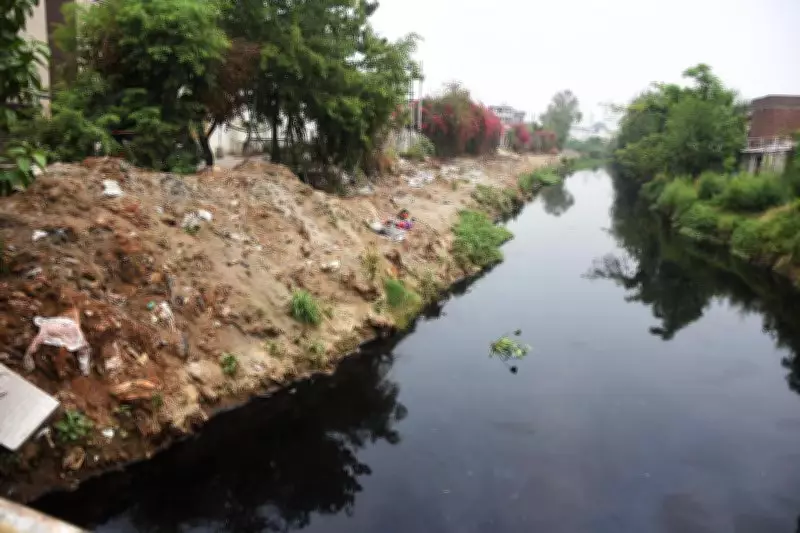
Buddha Nullah Rejuvenation Project: 6 Years On, Fresh Controversy Erupts
Ongoing construction activity violates environmental safeguards, drawing the ire of the National Green Tribunal (NGT), which has directed the Punjab government to halt all types of construction in the catchment areas of Buddha Nullah.
Six years after the launch of the ambitious Rs 840-crore Buddha Nullah rejuvenation project in Ludhiana, fresh controversy has erupted over the construction of a retaining wall in the nullah’s catchment area. The NGT has also sought detailed maps from the Punjab Pollution Control Board (PPCB).
Residents of New Deep Nagar, located close to the nullah, have alleged that work on the retaining wall and road construction is continuing despite the NGT’s clear directions.

For nearly three decades, Buddha Nullah has been one of Punjab’s most pressing environmental challenges. Successive governments have repeatedly promised to clean the heavily polluted watercourse, courts have closely monitored the issue, and more than Rs 1,500 crore has been spent on various projects. Yet, the nullah continues to carry black, polluted water in many stretches before merging with the Sutlej River.
The cleanup efforts began in the 1990s under the Sutlej Action Plan. Over the years, funds were allocated for sewage treatment plants (STPs), pumping stations, dairy waste management systems, and bio-remediation projects. By 2010, the Punjab government had informed the Punjab and Haryana High Court that Rs 377 crore had already been spent on cleaning the nullah.
Later, a major Rs 840-crore project was launched to rejuvenate Buddha Nullah in 2020. Additionally, more than Rs 50 crore was spent on developing roads, fencing, lighting, and landscaping along its banks. Even today, the government spends around Rs 1 crore annually on desilting the nullah.
Authorities claim that most of the project work has been completed. Data from the PPCB also indicates improvement in water quality at several monitoring points. Pollution levels at Walipur, Tajpur, and Haibowal have declined compared to previous years, and Common Effluent Treatment Plants (CETPs) are showing better performance. However, the watercourse continues to carry sewage, dairy waste, and other pollutants at multiple locations.
Rajya Sabha MP Balbir Singh Seechewal, who has been actively involved in cleaning efforts for years, notes that direct discharge of dyeing waste has largely been stopped. Still, he highlights that concerns persist regarding discharges from CETPs and pollution at several spots. According to him, “the battle is far from over.”
The Buddha Nullah story highlights a larger challenge facing Punjab. While infrastructure has been created and pollution indicators have improved on paper, public confidence remains low because the visible condition of the nullah has not changed to the extent people expected. As the polluted waters continue to enter the Sutlej, the impact is felt far beyond Ludhiana. The river system supports agriculture and groundwater resources across large parts of Punjab and even downstream areas of Rajasthan.
After almost 30 years of clean-up efforts, the question remains: can Punjab finally transform Buddha Nullah from a symbol of environmental neglect into a success story of river restoration?






