Bhopal's Air Quality Crisis Intensifies as Leaf and Garbage Burning Persists
Residents across Bhopal are expressing mounting concern over the persistent smoke generated from leaf and garbage burning, a practice that continues unabated despite repeated appeals for cessation. The suffocating haze that blankets neighborhoods has triggered a surge in complaints to the municipal corporation, with citizens describing deteriorating air quality that directly impacts their daily lives and health.
Civic Body Demands Visual Evidence for Enforcement Action
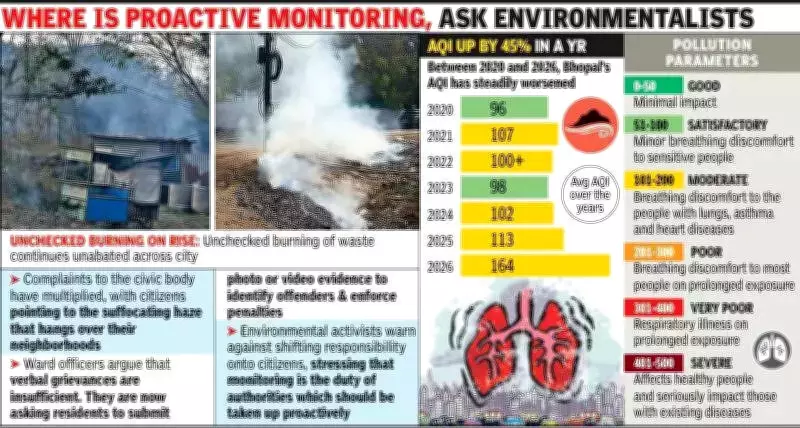
Ward officers have responded to the escalating complaints by implementing a new requirement: residents must now submit photographic or video evidence of burning incidents. Municipal authorities argue that verbal grievances alone are insufficient for effective enforcement. Documented proof will enable identification of offenders and facilitate the imposition of penalties, according to civic officials who emphasize this procedural shift.
"Every evening, smoke rises from waste piles and settles in our homes," reported a resident from the Smart City development area. "Ward officers should conduct proactive patrols rather than waiting for formal complaints. Without swift intervention from authorities, this environmental hazard will only intensify."

Alarming Air Quality Data Reveals Steady Deterioration
The urgency of addressing this issue is starkly reflected in Bhopal's air quality metrics from 2020 through 2026:
- 2020: AQI of 96
- 2021: AQI climbed to 107
- 2022: AQI remained steady
- 2023: AQI dipped slightly to 98
- 2024: AQI rose again to 102
- 2025: AQI reached 113
- 2026: AQI surged to 164
This trajectory reveals a particularly concerning 45% increase in air pollution levels between 2025 and 2026 alone. Over the entire seven-year period, Bhopal has experienced an 11% overall deterioration in air quality, with residents identifying leaf and garbage burning as a visible and significant contributor to this decline.
Enforcement Gaps and Citizen Responsibility Debates
While BMC officials maintain they are actively penalizing offenders, recent incidents have raised questions about enforcement effectiveness. Last month, approximately one ton of polythene was burned at Roshanpura. When questioned about the complaint days later, a zone officer insisted on video evidence—despite smoke being visible from a kilometer away. Residents allege the shopping mall owner responsible escaped penalty entirely.
Environmental activists have criticized the shifting of monitoring responsibility onto citizens. "Environmental monitoring constitutes a fundamental duty of municipal authorities," emphasized one campaigner. "While citizen participation can support enforcement efforts, it should never serve as a replacement for official oversight and action."
Public Health Imperative Demands Immediate Intervention
With air quality index levels climbing steadily and winter smog conditions intensifying, addressing leaf and garbage burning has transformed into both a civic governance challenge and a public health emergency for Bhopal. The combination of deteriorating air metrics, citizen frustration with enforcement mechanisms, and the approaching winter pollution season creates an urgent scenario requiring comprehensive municipal response and community cooperation to implement sustainable solutions.