

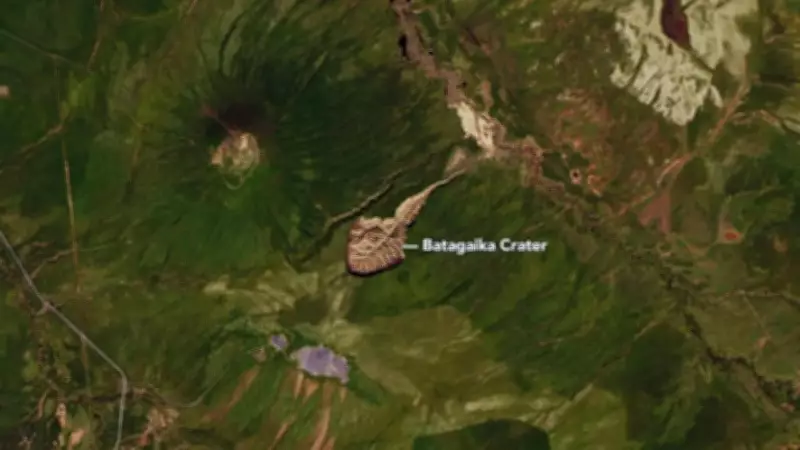
Batagaika Crater: Siberia's 'Door to the Underworld' Reveals Climate Secrets
In the remote and frozen expanses of eastern Siberia, a geological phenomenon of dramatic proportions has captured both scientific curiosity and local imagination. Often referred to as the "Door to the Underworld," the Batagaika Crater is not merely a striking visual anomaly; it stands as one of the most crucial natural laboratories for understanding Earth's climatic past and its rapidly evolving future.
A Living Scar in the Permafrost
This massive chasm represents a living, constantly expanding scar in the permafrost, a scar that was never intended to exist. Unlike other craters formed by meteorite impacts or volcanic eruptions, the Batagaika Crater's unique amphitheatrical shape results from thermokarst formation. This process involves a megaslump created by the thawing and erosion of ice-rich permafrost.
Located in the territory of Yakutia, within Russia's Sakha Republic, the crater began forming in the 1960s. The cause of this unusual phenomenon may seem trivial, yet it plays a pivotal role: deforestation removed the protective canopy that shielded the earth's surface from direct sunlight, thereby preventing freezing. Without this insulation, the ground started melting from the inside out, causing surface collapse and exposing deeper thawing layers, initiating a vicious cycle of expansion.

Dimensions and Mythical Origins
Currently, the Batagaika Crater spans approximately one kilometre in length and reaches depths of 80 to 100 metres, earning its status as the world's largest permafrost slump. The origin of its eerie name, "Door to the Underworld," stems not only from its intimidating appearance but also from local myths. Its walls feature jagged edges resembling a great wound carved into the earth. During warmer months, as ice melts and soil shifts, the ground emits cracking and rumbling sounds, enhancing its ominous reputation.
For local communities, this rapidly expanding and visually dramatic feature has long been shrouded in mystery. However, the true narrative behind Batagaika is rooted in science, climate dynamics, and the passage of time.
A Geological Archive Frozen in Time
The uniqueness of the Batagaika Crater extends beyond its dimensions to its content. As the permafrost continues to melt and sink, it reveals layers of sediment, organic material, and ground ice of incredible antiquity. These layers function like pages in a historical book, offering scientists a rare opportunity to study:
- Climatic cycles from ancient eras
- Changes in vegetation over millennia
- Atmospheric conditions long past
Some of the deposits uncovered by the melting are over 650,000 years old, making this one of the most ancient accessible permafrost records on our planet. In addition to soil and plant matter, the region has yielded remains of Ice Age fauna, including woolly mammoths, steppe bison, and ancient horses. These discoveries aid researchers in reconstructing prehistoric Siberia, providing insights into how species adapted or failed to adapt to changing climates.
A Visible Sign of a Warming Planet
While Batagaika offers invaluable insights into the past, it equally serves as a stark warning about the future. The rapid expansion of the crater is directly linked to climate change and the accelerated thawing of permafrost across the Arctic region. Permafrost is not merely frozen earth; it acts as a massive carbon sink that has preserved organic matter for millennia. As it thaws, this organic matter decomposes, emitting greenhouse gases such as carbon dioxide and methane.
This creates an alarming vicious cycle: thawing leads to greenhouse gas emissions, which in turn accelerate further thawing. The Batagaika Crater exemplifies this phenomenon vividly, with studies showing that its edges can recede by several meters annually, particularly under warm weather conditions.
Although global warming drives the crater's growth today, human activities were responsible for its initial formation. Deforestation in the 1960s stripped away insulating vegetation, triggering the thawing process that birthed the crater. Thus, Batagaika illustrates how even minor human interventions can have profound impacts on fragile ecosystems, especially in the Arctic and sub-Arctic zones.

Often dubbed a gateway to hell, the Batagaika Crater is, in reality, a gateway to our planet's past and a harbinger of its future. As it continues to expand, it unlocks secrets buried within frozen soil layers, reminding us of the delicate balance between human actions and natural processes.





