

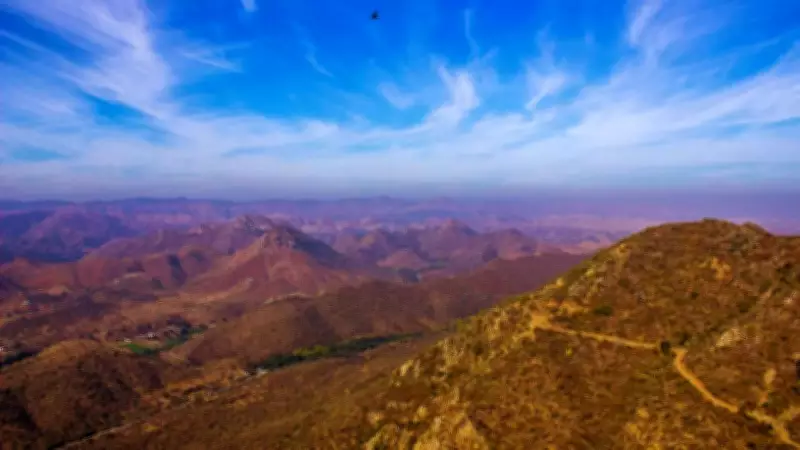
Aravalli Mountains Face Accelerating Soil Erosion Despite Forest Cover Growth, Study Reveals
NEW DELHI: A comprehensive environmental study has uncovered alarming trends in India's ancient Aravalli mountain range, where a dramatic 53% expansion of built-up areas between 2017 and 2024 has triggered a significant 13.8% increase in average annual soil loss, even as forest cover has shown measurable growth during the same period. This paradoxical finding underscores how local conservation efforts are being overwhelmed by large-scale, unsustainable land conversion processes.
Detailed Analysis of Land Use Patterns and Erosion Hotspots
Researchers from O.P. Jindal Global University and the Indian Institute of Technology Kharagpur conducted an extensive assessment of land use and land cover patterns spanning from 2001 to 2021. Their investigation identified that steep slopes, vulnerable soil compositions, and active mining zones are strongly correlated with erosion hotspots throughout the Aravalli Mountain System.
The study, published in the academic journal Geographies, utilized moderate-resolution data from 2001-2020 to establish long-term trends, while employing high-resolution data from 2017 and 2024 to precisely quantify recent erosion patterns. These two years were specifically selected to represent current and divergent meteorological conditions, providing a robust comparative framework.

The Paradox of Increased Afforestation Amidst Rising Erosion
While the research confirmed "an evident growth in overall forest cover at a broad spatial scale," fine-scale measurements revealed a troubling counter-narrative. Erosive processes have intensified alongside a sharp proliferation of built environments, accompanied by a noticeable depopulation of traditional rangelands and croplands.
"LULC (land use and land cover) has changed rapidly, with built-up areas increasing by 53 per cent at the expense of rangelands and croplands," the authors documented. "These drivers resulted in a 13.8 per cent increase in the mean annual soil loss between 2017 and 2024, from 1.59 to 1.81 tonnes per hectare per year, while forest cover has increased over the timescale, as is evident in this study."
Ecological Vulnerability of Ancient Mountain Systems
The Aravalli range represents one of Earth's most primitive mountain formations, characterized by deep soils and intricately balanced, delicate ecosystems. Simultaneously, it stands as one of India's most mineral-rich mountain systems, hosting diverse metallic and non-metallic mineral deposits that form a cornerstone of the nation's mineral resource base.
Researchers emphasized that the conversion of semi-natural vegetation surfaces to impervious built environments directly undermines the land's natural defense mechanisms against erosion. This transformation pattern mirrors trends observed in ancient mountain systems worldwide, where human development pressures intersect with fragile geological structures.
Interconnected Impacts of Human Activity and Climate Change
The study identified a dual-threat scenario where human-caused landscape erosion coincides with increased climatic erosivity between 2017 and 2024. This interdependence creates a vicious cycle: human activities increase environmental exposure to degradation, while climate change amplifies natural hazards.
"The interdependence of human activity and climate change, in which human activity increases exposure and climate change increases hazards, is characteristic of the contemporary degradation of vulnerable ecosystems across the globe," the authors noted. "As a result, a 13.83 per cent increase in mean soil erosion rates became a direct and foreseeable effect."
Broader Implications for Conservation Strategies
The research team highlighted a critical insight for environmental policy: "These results highlight the fact that local conservation benefits, such as afforestation, can be swamped out by large, unsustainable land conversion processes."

They further explained that the primary threat to landscapes isn't merely a lack of forest cover, but rather the disintegration and transformation of the larger, stabilizing land matrix, which subsequently affects downstream ecosystems. This comprehensive analysis provides crucial evidence for reevaluating land management approaches in ecologically sensitive mountain regions facing development pressures.





