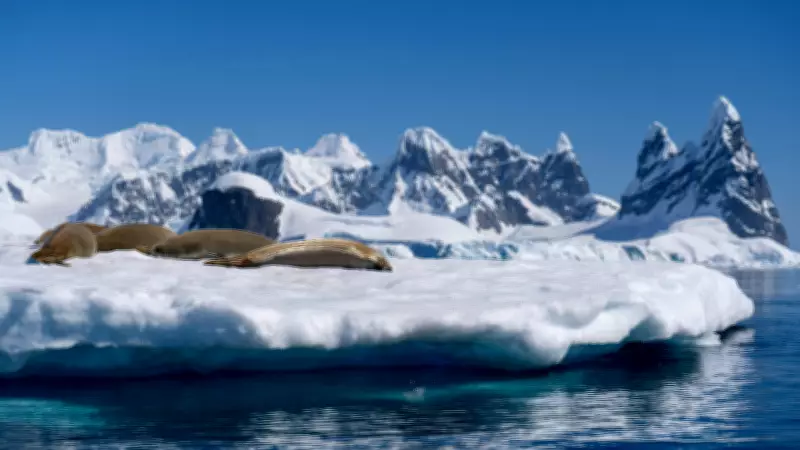
Antarctica has long been viewed as Earth's frozen shield, vast and seemingly unbreakable. However, scientists now warn that some of its most fragile regions may have crossed a dangerous threshold. What was once a slow, measurable retreat of ice is increasingly described as something far more serious: a tipping point. This so-called 'nightmare scenario' suggests that parts of Antarctica could continue melting regardless of future climate action. While the process unfolds over centuries, its consequences, especially rising sea levels, could reshape coastlines and communities worldwide.
Antarctic Ice Sheet Tipping Point Explained
At the core of this problem is the West Antarctic Ice Sheet (WAIS), considered one of the most unstable regions of the continent. Experts regard it as an 'example of a tipping element' for Earth's climate system, meaning that once a certain threshold is reached, changes become irreversible. Latest research indicates that some areas in Antarctica may have already reached such a tipping point. According to a study involving the Potsdam Institute for Climate Impact Research, key ice basins have temperature thresholds of 1–2°C above pre-industrial levels, which our planet has nearly achieved. Moreover, the concept of hysteresis suggests that the melting process does not stop even if temperatures stabilize. Researchers note: 'The ice sheet cannot stop melting even if global warming is contained.' This is why it is termed the point of no return.
Why Is West Antarctica Melting Irreversibly?
The rapid melting is driven not only by higher atmospheric temperatures but also by warmer ocean waters. For instance, the Amundsen Sea's relatively warm waters flow underneath ice shelves, accelerating their melting. This undermines their ability to hold back inland glaciers. Once melted, glaciers move faster toward the ocean, causing additional ice loss. This is part of what is known as Marine Ice Sheet Instability. Another critical factor is that most of West Antarctica's ice sheets are located below sea level. Consequently, once retreat begins, glaciers become exposed to even warmer waters, perpetuating the cycle. According to Nature Communications, once temperatures rise above 1.8°C, 'irreversible loss' of ice sheets becomes inevitable.

Global Impact of Antarctica's Melting Crisis
The ramifications extend far beyond Antarctica. A complete melt of the WAIS would result in a sea level rise of several meters over an extended period. Predictions suggest such melting could eventually lead to a sea level rise of approximately 4 meters, fundamentally redefining Earth's coastlines. What makes this issue alarming is that there is very little that can be done to prevent it. It appears to be a matter of time, and scientists believe that once initiated, the process would take centuries or even millennia to unfold. As one scientist put it: 'It takes tens of thousands of years for an ice sheet to form, but decades to make it unstable.' Scientists emphasize that although some damage is already done, efforts can still be made to prevent further escalation. In other words, the fate of Antarctica is tied to the fate of our planet's coastlines, climate, and humanity as a whole.