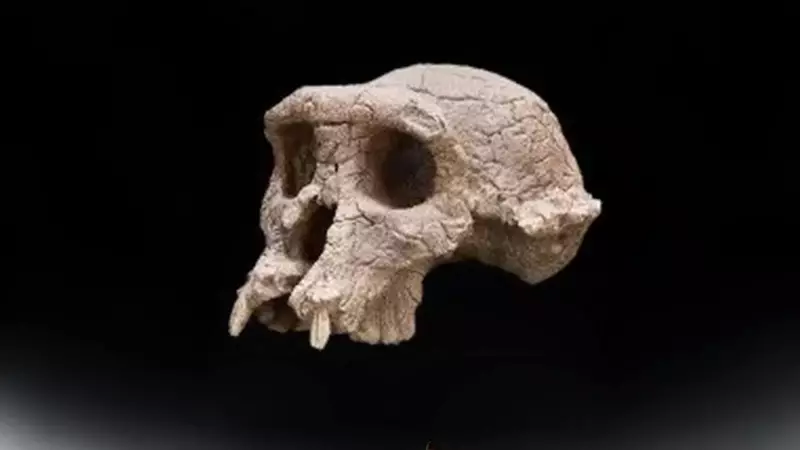
One of the most profound mysteries in the story of human evolution is pinpointing the moment our ancestors first stood up and walked on two legs. A fresh scientific investigation now suggests that crucial evidence, hidden in fossil bones over 7 million years old, may be bringing us closer to answering that pivotal question.
Anatomy Points to a Two-Legged Stride
In a significant new study, researchers present a compelling case that Sahelanthropus tchadensis, an ancient, ape-like species that roamed Africa approximately 7 million years ago, exhibits clear anatomical signs of upright movement. Widely considered the oldest known member of the human lineage after the evolutionary split from chimpanzees, a re-analysis of its fossilised remains is challenging previous assumptions about how early hominins moved.
While Sahelanthropus would have outwardly resembled a modern ape, the study argues its bone structure was better adapted for walking on two legs than for moving on all fours. The research team concludes the creature likely walked upright at least some of the time, marking a critical juncture in our evolutionary history.
"It would have looked much like an ape, probably closest to a chimpanzee or bonobo," explains Scott Williams, an associate professor at New York University and the lead author of the study. "But while those animals occasionally walk upright, this species shows adaptations that point toward regular bipedal movement."
Reviving a Decades-Old Scientific Debate
These findings reignite a long-standing controversy that began when fossils of Sahelanthropus were first unearthed in 2001 in Chad's Djurab Desert. The discovery initially sparked both excitement and scepticism. Some scientists, largely based on the position of the skull, proposed the species could be a direct ancestor of modern humans. Others remained doubtful, arguing there was insufficient evidence to confirm upright walking.
Later discoveries of forearm fragments and a partial thigh bone failed to resolve the disagreement. Experts were divided on whether the bones belonged to an ape with a unique mode of locomotion or to a bipedal hominin. For the latest study, Williams and his team employed modern imaging techniques to re-examine these very limb bones. They compared their shape, proportions, and 3D structure with fossils from known hominins and non-human apes.
A key anatomical feature emerged: a small projection on the thigh bone linked to a powerful ligament that stabilises the body during standing and walking. The researchers contend this trait, observed only in bipedal relatives within the human family tree, helps prevent the torso from swaying during upright motion.
Gradual Evolution and Lingering Questions
Based on the available evidence, the early hominin most likely walked on two feet but also spent considerable time in trees for food and shelter. This mixed behaviour supports theories that bipedalism evolved gradually, not in a single, dramatic evolutionary leap.
However, not all scientists are convinced. Some critics maintain the fossil evidence is still too scant for definitive conclusions, pointing out similarities between Sahelanthropus bones and those of modern African apes. A central debate persists: whether the animal primarily used upright walking on the ground or in the trees, a distinction crucial for defining the human lineage.
Proponents of the new analysis acknowledge that more fossils are needed to settle the argument conclusively but emphasise the value of the renewed scrutiny. There is hope that excavations at the original site in Chad will resume, potentially yielding discoveries that finally clarify when and how humanity took its first, momentous steps.