Imagine having a time machine that could transport you back to the very dawn of our planet, capturing vivid images of its primordial landscape. While this sounds like science fiction, geologists have discovered that such a time machine exists, not in a lab, but embedded in the ancient bedrock of Southern Africa.
A Geological Window to a Primordial World
In the remote Makhonjwa Mountains of South Africa and the neighbouring kingdom of Eswatini, scientists have uncovered a treasure trove of rocks that serve as a direct portal to Earth's distant past. These formations are staggeringly ancient, dating back more than 3.5 billion years—covering over three-quarters of our planet's 4.6-billion-year history. Research into these rocks, as detailed in the book The Oldest Rocks on Earth, paints a dramatic picture of our world's infancy.
The ancient landscape revealed was one dominated by vast oceans and intense volcanic activity on the seafloor. Earth's interior was far hotter, producing unique white-hot magmas. Superheated water, rich in minerals, gushed from underwater vents, building metallic chimneys. Crucially, this violent environment was already hosting life, with microbial mats thriving around these hydrothermal systems.

Violence and Vitality: The Cradle of Life
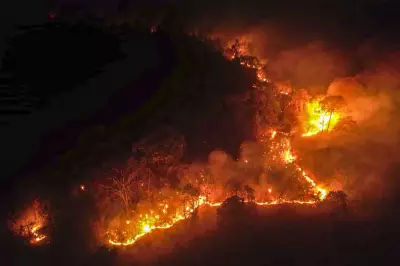
This early Earth was a dynamic and perilous place. Volcanic islands rose from the deep, their shores dotted with pools of bubbling mud and periodically shaken by explosive eruptions. The atmosphere was a toxic mix of methane and carbon dioxide, with no breathable oxygen. Yet, this greenhouse gas blanket was essential, keeping the planet warm enough for liquid water under a fainter young Sun.
Life, in the form of anaerobic microbes possibly coloured pink or purple, persisted despite the chaos. The scene was periodically scarred by giant asteroid impacts and shaken by massive earthquakes that triggered underwater avalanches. Through it all, the planet was unmistakably blue, as oceans scattered sunlight much as they do today.
Oceania as a Modern Analogue and the Spark of Life
To visualize this ancient world, scientists point to the modern-day region of Oceania in the southwestern Pacific. This area, with its volcanic islands, tectonic earthquakes, and deep-sea vents, mirrors the conditions of primordial Earth. It also offers clues to life's origins. The cataclysmic 2022 eruption of the Hunga volcano near Tonga, which generated massive lightning storms, provides a model.
Experiments suggest such lightning strikes in chemically rich environments, like those in underwater volcanic craters, can synthesize basic organic molecules. Millions of similar violent eruptions on early Earth could have provided countless opportunities to kick-start the chemistry that led to living organisms. In essence, life was born from extreme geological violence.
Earth's unique and enduring blue character—referred to poetically in Siswati as luhlata lwesibhakabhaka (green like the sky)—was secured by its position in the Goldilocks Zone, its size, a stabilizing Moon-forming collision, and later, the biochemical processes of life itself that helped regulate the climate. This research underscores not just our planet's violent birth, but the delicate balance that has maintained it as a living, blue world for billions of years.