

The administration of Brazilian President Luiz Inacio Lula da Silva frequently highlights its success in sharply reducing deforestation in the Amazon. Indeed, when the next official annual numbers are released in October, the deforestation rate is expected to be the lowest since 2012. However, despite these gains in preserving forest cover, many other threats—ranging from climate change to potential legislation—are putting the rainforest at risk.
Forest Degradation: A Chronic Condition
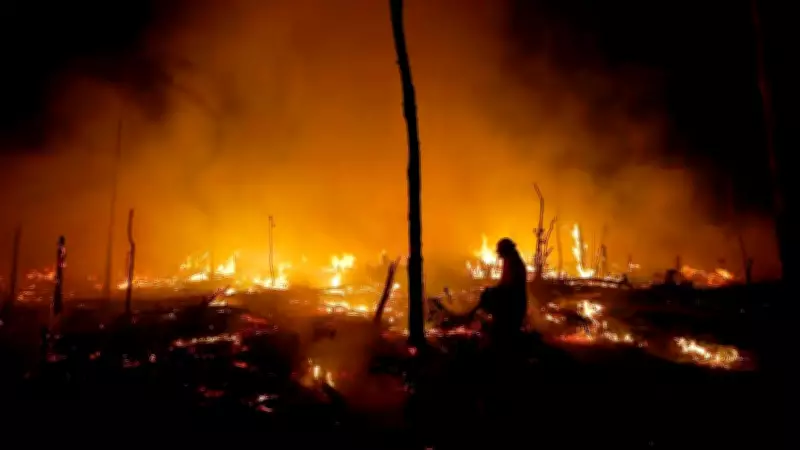
Forest degradation, driven by wildfires, logging, and drought, affects approximately 40% of the Amazon and has outpaced clear-cutting in recent years. This situation could worsen in 2026 with a strong El Nino, a cyclic warming of the equatorial Pacific that brings higher temperatures and drier weather to the rainforest, exacerbating wildfire conditions. Taciana Stec, a climate policy specialist at Talanoa, a Brazilian climate think tank, described degradation as "slower and more silent. It is like a chronic condition."
While the Amazon still functions as a carbon sink—absorbing vast amounts of planet-warming carbon dioxide—it could reach a tipping point beyond which it cannot recover. At that stage, the forest might emit more CO2 than it absorbs. Scientists warn that repeated stress could trigger a regional or biome-wide collapse. A 2024 study published in Nature estimated that by 2050, between 10% and 47% of the Amazon could be pushed into conditions capable of causing such a critical shift.

Degradation Chronically Weakens the Rainforest
The Amazon spans nine South American countries, with Brazil holding more than 60% of the forest. Consequently, what happens in Brazil impacts the entire region. In Brazil, the official annual deforestation rate covers August to July. Preliminary data from DETER, Brazil's satellite-based real-time alert system, show that both deforestation and forest degradation have significantly declined since last year. However, degradation continues to outpace deforestation. From August 2025 through April 2026, deforestation alerts covered nearly 1,700 square kilometers (656 square miles), while degradation affected about 4,420 square kilometers (1,706 square miles).
The DETER system provides daily alerts of ongoing deforestation—complete clear-cutting—and degradation, which includes areas affected by human activity where soil is exposed but the forest has not been fully lost. During the 2023 and 2024 El Nino, temperatures rose 2 to 4 degrees Celsius (3.5 to 7 Fahrenheit) above the forest's historical average. Combined with severe drought, this heat fueled the Amazon's worst wildfires in two decades, and forest degradation increased at a rate roughly three times greater than the decline in deforestation. A study by Guilherme Mataveli, a researcher at Brazil's National Institute for Space Research (INPE), showed that the combined effect resulted in a net loss of rainforest, undermining deforestation progress.
A degraded rainforest may still be standing, but it can no longer fully support the ecosystem. This weakness could be compounded by external factors like El Nino. For example, if the Amazon were a human patient with a chronic illness, El Nino would strike like a flu, triggering a fever that leaves the body weaker and more vulnerable. Two years later, the flu returns, but the patient has not fully recovered, so the fever burns hotter and the illness hits harder.
Assessing a forest in this state is relatively new to scientists, as identifying degradation through satellite images is more complex than detecting tree-cutting. However, they have increasingly warned about its prolonged and dangerous effects. Experts say this new scenario requires the government to prioritize forest restoration. Brazil plans to restore 12 million hectares (29.7 million acres) of native Amazon forest by 2030, as part of its commitment under the 2015 Paris Agreement. According to the Environment Ministry, 3.4 million hectares (8.4 million acres) are already undergoing recovery.
Above all, the country must continue its efforts to curb deforestation, experts say. However, a fast-tracked bill in Congress threatens the main tool that enabled Brazil to reduce deforestation.

Proposal Would Make Key Change in Forest Monitoring
If approved, the legislation proposed by lawmaker Lucio Mosquini would prohibit IBAMA, Brazil's environmental enforcement agency, from imposing sanctions on landowners for illegal deforestation based solely on satellite monitoring—a pillar of the country's environmental enforcement. Mosquini argues that satellite-based sanctions harm farmers because they are not given a chance to mount a defense. Authorities, however, say farmers can challenge the sanction within 20 days and have it overturned if they can show the deforestation was authorized.
IBAMA first began relying on satellite data in 2016 to complement field inspections and support deforestation control in remote areas. Former President Jair Bolsonaro's administration halted the policy in 2019 as part of its environmental deregulation efforts, which drove Amazon deforestation rates to a 15-year high in 2021. Under Lula, who returned to office in 2023, the environmental agency resumed remote monitoring. Since March, the proposal has been set for an eventual vote by Congress' lower chamber. If it passes, it would move to the Senate. Since agribusiness is the country's most powerful economic sector and most influential in Congress, political experts expect it to be approved.
If approved, the project would be "a major environmental setback," Jair Schmitt, IBAMA's president, told The Associated Press. "In effect, you end up encouraging environmental offenders and unfair competition." Schmitt compared satellite technology to speed cameras: it supports environmental enforcement much as speed cameras assist traffic authorities. It would be impossible for a city to deploy a guard to every corner, and likewise, the federal government cannot station agents on every square kilometer of the rainforest.
Authorities on High Alert with Prospect of Bad Wildfire Season
In March, the government announced the hiring of 4,600 firefighters and launched real-time monitoring of potential fire outbreaks. Schmitt said authorities have identified rural properties at high fire risk by combining historical heat-spot data with deforestation and weather records. Some landowners are now being notified and ordered to adopt preventive measures.
"The situation this year is worrying. We're still in the rainy season, and we've already recorded two fires in April," said Tainan Kumaruara, a member of the Indigenous volunteer Guardioes Kumaruara fire brigade in the Kumaruara Indigenous land in Para state. "The forest is different from what it was 10 years ago. It's much drier. The trees no longer behave as they did," she added.
In 2024, a major wildfire season fueled by severe drought affected more than 17 million hectares (42 million acres) of rainforest, according to MapBiomas, a nonprofit that tracks land use. Most wildfires in the Amazon are not natural but rather started by humans.
Amid the warnings, a study published in April by Proceedings of the National Academy of Sciences added more evidence about how the Amazon recovers from fire. For 20 years, Leandro Maracahipes, a Yale University researcher supported by the Brazilian nonprofit Instituto Serrapilheira, set controlled fires at a research farm in the Amazon that was also exposed to drought. The study found that after frequent wildfires, the forest did not completely disappear or transform into savanna or widespread grassland, contrary to what scientific models had predicted. It remained a rainforest but degraded, with more clearings and vulnerability, lacking Amazon niche species that depend on dense cover and specific conditions—and time—to germinate and grow.
"The forest is resilient, but our message is that we need to preserve it even more, and urgently," Maracahipes said. "And it has to be now."





