

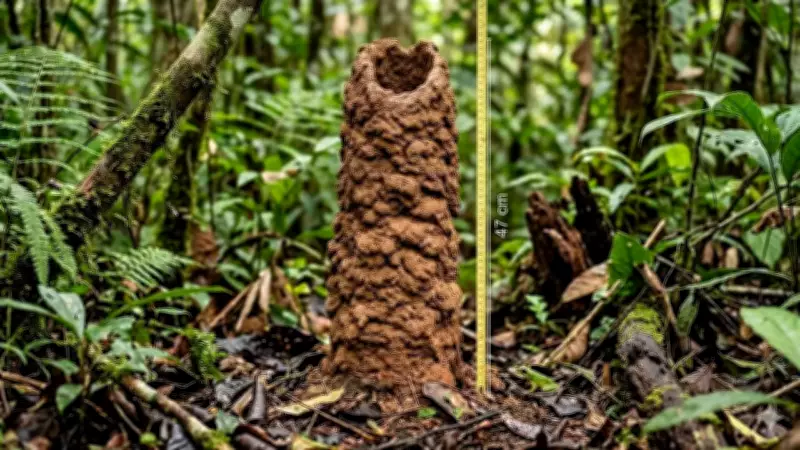
Scientists Decode Mystery of Amazon's Giant Clay Chimneys Built by Cicadas
In a groundbreaking discovery, researchers have finally unraveled the purpose of the bizarre clay chimneys found at the base of the Amazon rainforest. This revelation comes from an extensive field study conducted in and around Manaus, Brazil, led by the Serrapilheira Institute, with findings published in the prestigious scientific journal Biotropica. The study documented a record-setting 47-centimetre-high cicada tower, the tallest ever recorded, constructed by the species Guyalna chlorogena.
Record-Breaking Cicada Towers in the Amazon
The Serrapilheira Institute's reports detail an extensive exploration of the Manaus region to evaluate the architectural forms of cicada species. One of the major discoveries was a clay structure, often referred to as a 'clay chimney,' measuring 47 centimetres in height. This tower surpasses all previously documented records for Guyalna chlorogena. Cicada nymphs construct these large towers using mud and soil excavated from underground. Reaching such heights is an exceptional biological feat, requiring the nymphs to transport vast amounts of sediment from their tunnels to the surface, all while enduring the humid Amazon climate.
Innovative Condom Method Proves Gas Exchange Function
Led by Renato de Jesus Rodrigues, the research team employed a unique 'gas trapping' method to prove the towers' function. Scientists used 40 latex condoms to seal the openings of the clay chimneys, allowing them to monitor carbon dioxide build-up and oxygen intake within the structures. The condoms served as flexible, airtight membranes, providing the first empirical evidence that these towers are active respiratory systems. The study in Biotropica demonstrated that the towers facilitate significant gas exchanges for nymphs living in hypoxic conditions, debunking the idea that they are merely arbitrary mounds.

The 'External Lung' Hypothesis and Survival Strategy
The towers are believed to function as an 'extended phenotype'—an anatomical feature outside the organism that enhances survival. This is crucial in the swampy, compact soils of the Amazon, where nymphs face high risks of hypoxia and flooding. The 47-centimetre-high towers support the 'external lung' hypothesis by utilizing the Venturi effect and diffusion to draw oxygen into deep tunnels. Additionally, the height offers protection from terrestrial predators, such as foraging ants, and prevents flooding during heavy rains, ensuring the cicadas' burrows remain safe and functional.






