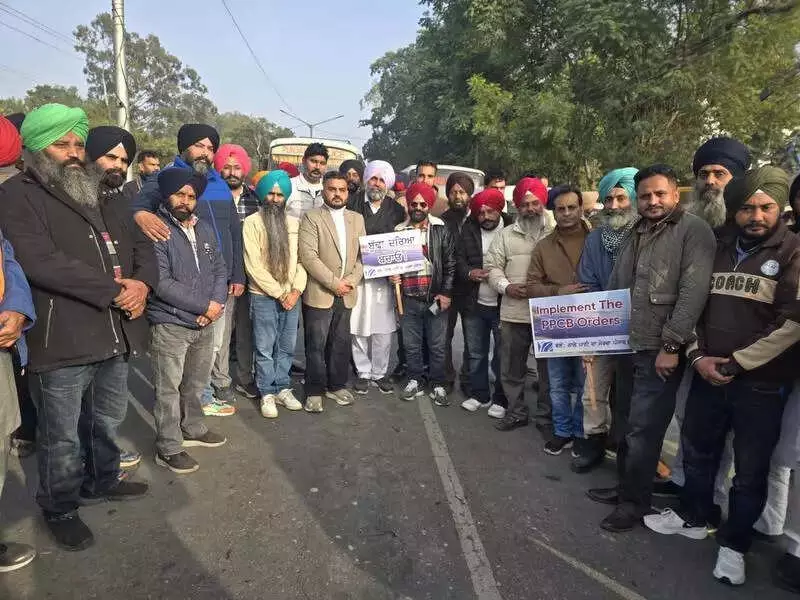
Environmental activists staged a high-tension protest at the Punjab Pollution Control Board (PPCB) headquarters in Jaipur on Thursday, demanding urgent action to halt the flow of untreated industrial waste into the seasonal Buddha Dariya river. The demonstration, organized under the banner of 'Kale Pani Da Morcha', centered on the immediate implementation of directives from the National Green Tribunal (NGT) and other statutory bodies.
Cross-Border Threat to Water Security
The protest highlights a severe inter-state environmental and public health issue. The polluted waters from Buddha Dariya flow into the Sutlej River and then enter Rajasthan's canal network, including the Indira Gandhi Canal Project, Sirhind Feeder, and Bikaner Canal. This contaminated water supplies drinking and irrigation water to arid districts like Sriganganagar, Bikaner, and Hanumangarh, making the canal network a lifeline for the region.
The Rajasthan government has repeatedly urged Punjab to ensure only treated water is released into the river system, but protesters claim no concrete action has been taken so far. This inaction, they argue, jeopardizes the health and livelihoods of millions in both states.

Chronic Violations by Ludhiana CETPs
At the heart of the dispute are three Common Effluent Treatment Plants (CETPs) in Ludhiana, with daily capacities of 15, 40, and 50 million litres. For over a year, residents and activists have sought enforcement against these plants, which have consistently violated their Environmental Clearance (EC) conditions.
Inspections conducted by the PPCB, the Central Pollution Control Board (CPCB), and the Union Ministry of Environment, along with NGT directives, have confirmed that these CETPs continue to illegally discharge untreated effluents into Buddha Dariya. Despite the evidence, enforcement has been persistently deferred.
Protests and Official Response
The recent protest follows a peaceful mobilization on December 3, 2024, when the Morcha submitted a detailed memorandum to the PPCB. The document catalogued inspections, violations, PPCB's own Section 33-A orders, and repeated NGT directions, including contempt proceedings. The board had assured a response by January 8, 2025, leading activists to return to its headquarters.
Thursday's meeting with PPCB officials was held under heavy police deployment, with barricades preventing activists from approaching the premises. Senior PPCB engineer Kuldip Singh stated that an NGT order from December 9, 2024, to stop discharge into Buddha Dariya could not be implemented as the matter was "sub judice" due to applications filed by Punjab Agro Chemicals (PAC).
A "Legally Indefensible" Excuse?
Activists swiftly countered this explanation. They clarified that the applications in question were execution petitions filed in July 2025 precisely because the PPCB failed to implement earlier NGT orders. They termed the board's stance "legally indefensible", arguing that interim court orders remain binding unless officially stayed.
Minutes from a recent hearing at the Union Ministry of Environment further revealed that while violations were acknowledged, no interim restraint was imposed, and no clear timelines for compliance were set. "This allows pollution to continue unabated," a green activist lamented, highlighting a pattern of regulatory paralysis.
Mounting Pressure for Accountability
The 'Kale Pani Da Morcha' protest underscores growing public frustration with the failure of regulatory mechanisms to curb industrial pollution. The issue transcends state boundaries, creating a shared ecological and humanitarian crisis for Punjab and Rajasthan. The activists' return to the PPCB headquarters signals their resolve to hold authorities accountable until the NGT's orders are fully executed and the flow of toxic waste into the vital river system is permanently stopped.