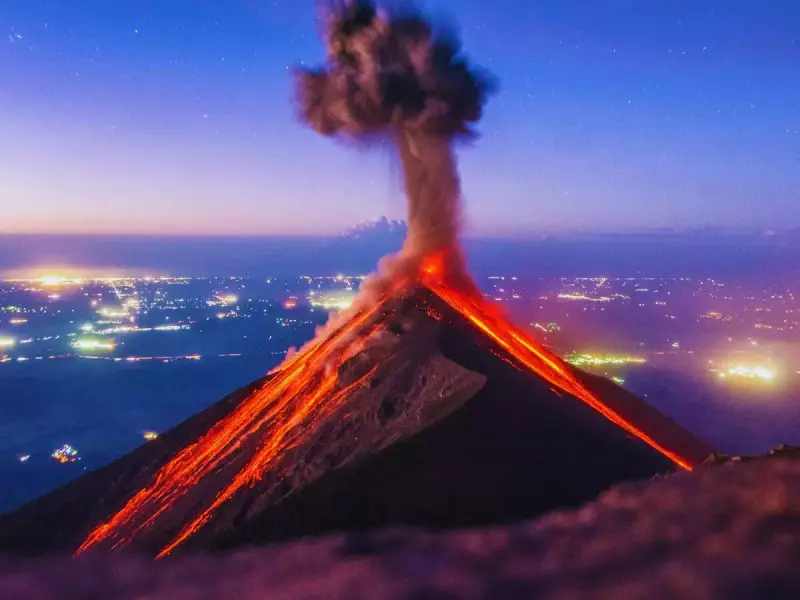
Volcanoes represent one of nature's most formidable and unpredictable forces, capable of reshaping landscapes and erasing civilizations in moments. While we classify them as active, dormant, or extinct, new scientific discoveries are challenging these very definitions. A startling revelation is emerging: several volcanoes, long considered 'dead' or extinct for tens of thousands of years, are showing signs of reawakening. Advances in satellite technology, seismic monitoring, and GPS data are peeling back the Earth's crust to reveal a dynamic and restless interior, forcing scientists to reconsider the life cycle of these geological giants.
The Science Behind the 'Zombie' Volcano Phenomenon
What does it mean for a volcano to be 'extinct'? Traditionally, it meant the volcano had not erupted in the last 10,000 to 100,000 years and was not expected to ever erupt again. However, this classification is now under scrutiny. Modern monitoring tools are detecting subtle signs of life—ground deformation, seismic swarms, and movement of hot fluids—beneath the surfaces of these sleeping titans. This doesn't necessarily mean an eruption is imminent, but it confirms that the magmatic systems beneath them are not entirely cold. This new category of volcanoes, sometimes called 'zombie volcanoes,' blurs the line between dormant and extinct, reminding us that our planet's geology is full of surprises.
Five Volcanoes Defying Their 'Extinct' Label
Let's explore five specific volcanoes across the globe where scientists have documented this unsettling reawakening.

Uturuncu Volcano, Bolivia: The Classic 'Zombie'
Nestled in the Andes of Bolivia, the Uturuncu Volcano earns its nickname as the 'Zombie Volcano.' Its last eruption was approximately 250,000 years ago. Despite this immense timescale, long-term monitoring reveals a startling phenomenon: the center of the volcanic structure is slowly rising while the surrounding land sinks. Data from seismic imaging and GPS networks indicate that hot fluids and gases are migrating upwards. For now, this movement does not involve eruptible magma, but the persistent activity has placed Uturuncu firmly in the scientific spotlight as a prime example of a reanimating volcano.
Taftan Volcano, Iran: Stirring After a 700,000-Year Slumber
Located in southeastern Iran, Taftan Volcano was a textbook example of an extinct volcano. That changed when a study published in Geophysical Research Letters presented evidence of surprising new activity. Having been dormant for nearly 700,000 years, this giant is showing clear, measurable signs that it is not as dead as once believed. This discovery in a seismically active region underscores the need for continuous monitoring of even the most ancient volcanic structures.
Mount Pelée, Martinique: A Notorious Giant Stirs Again
Mount Pelée on the Caribbean island of Martinique is infamous for its catastrophic eruption in 1902, which completely destroyed the city of St. Pierre and claimed an estimated 30,000 lives. After over a century of quiet, this deadly volcano is once again drawing the intense focus of volcanologists. In recent years, researchers have detected new signs of unrest, prompting authorities to heighten surveillance. The reawakening of such a historically destructive volcano serves as a potent reminder of their enduring threat.
Bolshaya Udina, Russia: From Extinct to Active
On Russia's remote Kamchatka Peninsula, Bolshaya Udina was officially classified as extinct. This status was abruptly revised in the late 2010s when a significant increase in seismic activity and ground movement was detected. The swarm of earthquakes beneath it was so pronounced that volcanologists formally reclassified it as an active volcano. This case powerfully illustrates that volcanoes with no record of historical eruptions can awaken with relatively little warning, challenging all prior assumptions.

Ciomadul, Romania: Dormant But Not Dead
The Ciomadul volcano in Romania's Eastern Carpathians last erupted around 30,000 years ago. Considered safely extinct, recent research has revealed a different story. Scientific analysis suggests that its deep magma chambers may still be partially molten, with the area exhibiting notable seismicity. This finding is crucial—it proves that even after tens of millennia of silence, a volcano can retain a live, albeit deep, magmatic system capable of fuelling future activity.
What This Means for Our Understanding of the Earth
The awakening of these 'dead' volcanoes has profound implications. It highlights significant gaps in our understanding of volcanic life cycles and risk assessment. For communities living near such volcanoes, even those considered long extinct, these discoveries argue for vigilance and investment in modern monitoring infrastructure. For science, it is a call to re-evaluate definitions and models. The Earth's interior remains a dynamic and enigmatic engine, and as our tools improve, we learn that its slumbering giants may only be taking a very long nap.