

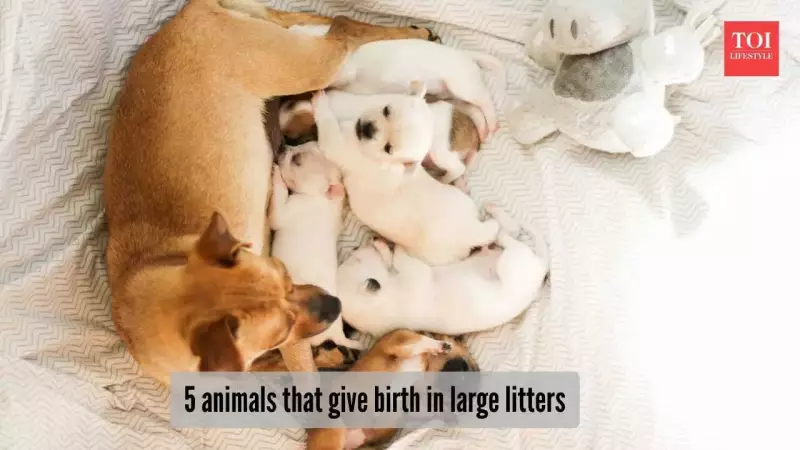
In the wild, where survival is a daily challenge, some animal species have adopted a remarkable reproductive strategy: producing exceptionally large litters. This high-stakes evolutionary gamble focuses on quantity, ensuring that even if many offspring are lost to predators or harsh conditions, enough survive to continue the species. From underground colonies to frozen tundras, this approach is a fascinating testament to nature's ingenuity.
Nature's Super Moms: Champions of Quantity
For these animals, giving birth to a crowd is the norm. This strategy is not about intensive parenting for a few but about maximizing the odds for at least some to reach adulthood. It's a direct response to environmental pressures like high predation rates, fluctuating food supplies, and extreme climates. The investment is in numbers, not individual care, making the early days of life a fierce competition for resources.
1. The Prolific Tailless Tenrec of Madagascar
Holding a record among mammals, the spiny, shrew-like tailless tenrec can deliver litters of up to 32 babies, with an average of around 18. Native to Madagascar, this creature is equipped with 26 teats to manage the chaotic feeding demands. The mother forages almost non-stop after birth to produce enough milk, weaning the survivors amidst intense sibling rivalry. This reproductive burst acts as a crucial population booster for island ecosystems where resources can vary dramatically.

2. The Eusocial Naked Mole Rat Queen
Living in complex underground societies similar to ants or bees, the naked mole rat queen is a birthing powerhouse. She gives birth to nearly 30 pups in a single litter. What makes this possible is the eusocial structure of the colony, where worker rats care for the young. This support system allows the queen to focus on reproduction, producing an average of 11 to 12 litters every year. Pups nurse freely without major limitations, preventing starvation and turning large litters into thriving underground communities in the harsh African soils.
3. The Rapidly Breeding European Rabbit
The European rabbit is so famous for its reproductive rate that it inspired the phrase "breed like rabbits." A single litter can consist of 4 to 12 blind, furless kits, and a female can have multiple litters each year. The newborns remain hidden in burrows while the mother makes brief foraging trips. This strategy of large, frequent litters is a direct counter to high predation from foxes and hawks. Survivors mature quickly, often in about a month, sustaining rabbit populations in fields across the globe.
4. The Arctic Fox and Its Tundra Brood
In the unforgiving Arctic tundra, the Arctic fox gives birth to one of the largest litters among wild mammals. In years when food like lemmings is abundant, a mother can have up to 20 to 22 pups, with an average litter size of around 11. The den becomes a hub of activity with fluffy kits, while the father hunts relentlessly to feed the large family. Harsh conditions claim many young, but producing extra pups helps secure the family lineage, with both parents offering fierce protection.
5. The Pouch-Bearing Virginia Opossum
North America's Virginia opossum gives birth to as many as 20 to 25 embryonic, pea-sized joeys. The race for survival begins immediately as these tiny newborns must crawl into the mother's pouch to find one of only 13 teats. Typically, only the first dozen or so that successfully latch on survive; the others perish. After about two months, the survivors emerge to ride on their mother's back. This marsupial relies on large numbers to counteract numerous threats, including cars, dogs, and owls in its habitat.

The Survival Logic Behind Massive Litters
The common thread among these diverse animals is a reproductive strategy shaped by environmental pressure. Whether it's the tenrec's island isolation, the rabbit's open-field vulnerability, or the Arctic fox's climatic extremes, large litters are an evolutionary adaptation to high mortality rates. It is nature's way of playing the odds, ensuring that even in the toughest environments, life finds a way to persist and thrive through sheer numbers.





