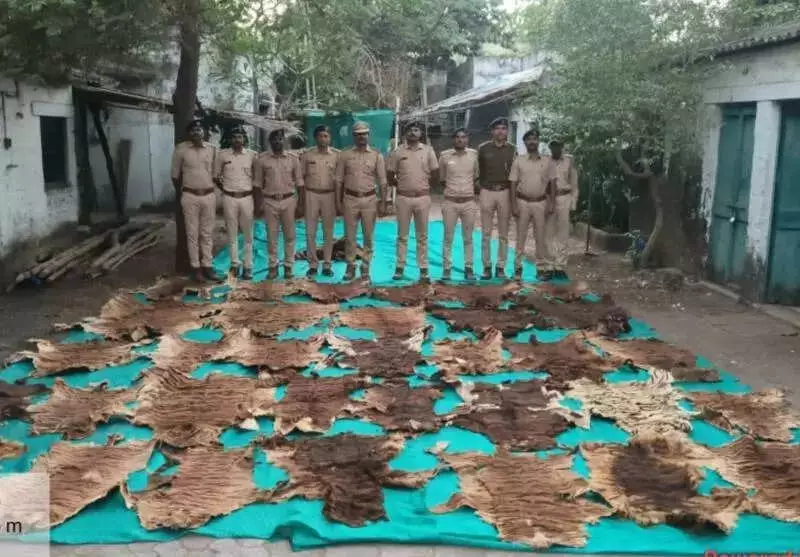
A startling discovery has sent shockwaves through the temple trust and forest authorities in Rajpipla, following the death of a long-time temple caretaker. The incident, which came to light in Ahmedabad and Vadodara, involved the unearthing of a large cache of suspected wildlife contraband from the deceased's private quarters.
The Macabre Discovery After a Death
Madhavanand, the 90-year-old caretaker of a temple in Rajpipla, passed away recently. His death prompted the temple management to plan the construction of a new building at his former residence. However, when officials finally entered his room, a room he had never allowed anyone to enter during his life, they were met with an astonishing and grim sight.
The search revealed an iron box packed with what appeared to be 37 tiger skins and 133 claws and canines. The sheer volume of the find left both the temple trust and the local forest department stunned and immediately triggered a major investigation.

Forest Department's Initial Findings and Action
The forest department was swift to respond. Jaipal Singh, the Principal Chief Conservator of Forests (Wildlife), stated that prima facie, the items appeared to be fake, with paint used to mimic the appearance of real tiger skin. "However, we are not taking any chances and are getting them examined," Singh emphasized, highlighting the seriousness with which the matter is being treated.
Echoing this, Narmada Deputy Conservator of Forests Abhay Singh provided further details. "Our initial tests revealed the skins were not real," he said. Despite the preliminary conclusion, the department has sent samples for advanced forensic analysis to the prestigious Centre for Cellular and Molecular Biology (CCMB) in Hyderabad to obtain a definitive answer.
Suspicions and an Ongoing Mystery
The case has taken a suspicious turn due to the caretaker's background. Forest officials noted that since Madhavanand was originally from Madhya Pradesh, a state with significant tiger populations and historical poaching issues, it raised red flags. The suspicion is that he may have been involved in illegal wildlife poaching and trade, using his secluded temple residence as a storage point.
The caretaker had stayed at the temple for several years, living a reclusive life that successfully kept his secret until his demise. The forest department's investigation is now focused on determining the origin of these items, whether they are genuine or sophisticated fakes, and if they are linked to broader poaching networks. The findings from the Hyderabad lab are eagerly awaited to solve this bizarre and troubling mystery.