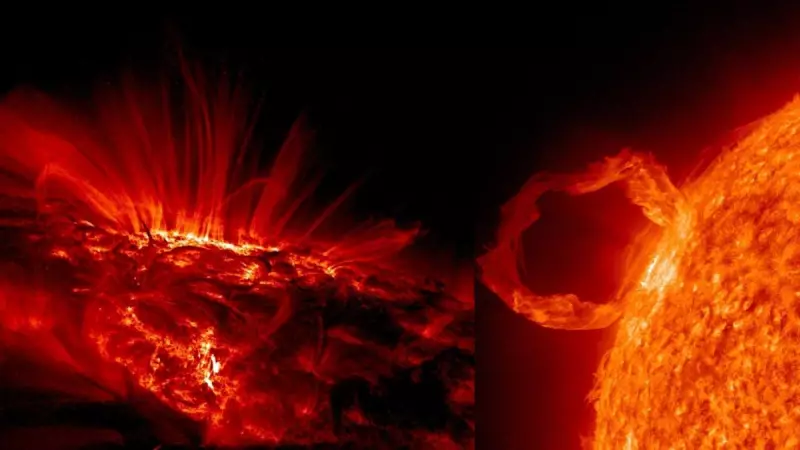
The Earth was struck by the most powerful solar flare of the year 2025, an event that sent a massive surge of radiation towards our planet. This significant solar eruption, which occurred on December 7, 2025, led to a dramatic spike in radiation levels, particularly in regions frequented by commercial aircraft.
Unprecedented Radiation Levels at High Altitudes
According to data released by the National Oceanic and Atmospheric Administration's Space Weather Prediction Center (NOAA SWPC), the solar event caused radiation levels to soar to approximately ten times the normal background levels at typical commercial flight altitudes. This spike poses a notable concern for aviation safety, especially for flights operating over polar routes and at high latitudes, where the Earth's protective magnetic field is weakest.
The flare originated from a highly active sunspot region on the Sun's surface. Such coronal mass ejections (CMEs) release vast amounts of charged particles and electromagnetic radiation. When these particles interact with Earth's magnetosphere, they can create a cascade of effects, from beautiful auroras to disruptive technological interference.

Immediate Impacts and Safety Protocols
The immediate consequence of this radiation surge is an increased health risk for airline crew and passengers on long-haul flights, particularly those crossing the polar regions. Aviation authorities and airlines are advised to monitor the situation closely. Pilots may be instructed to alter flight paths to lower latitudes or reduce cruising altitude to mitigate exposure, a standard protocol during such severe space weather events.
Beyond aviation, the solar storm has the potential to affect satellite operations. Satellites in low-Earth orbit can experience increased drag and potential electronic malfunctions due to the energized particles. Communication and navigation systems, including GPS, may also suffer from degraded performance or temporary blackouts during the peak of the storm's activity.
Auroral Displays and Continued Monitoring
On a more positive note, such powerful solar activity often leads to spectacular auroral displays. The NOAA SWPC has indicated that the geomagnetic storm resulting from this flare could push the aurora borealis (Northern Lights) much farther south than usual. Skywatchers in northern regions around the globe are on high alert for vivid night sky shows in the coming nights.
Scientists and space weather forecasters continue to monitor the Sun's activity. The current solar cycle is approaching its predicted maximum, making such intense flares more likely. This event underscores the importance of robust space weather forecasting to protect our technology-dependent infrastructure. Further updates on the storm's intensity and duration are expected from monitoring agencies worldwide.
This solar flare serves as a stark reminder of our Sun's dynamic power and its direct influence on modern life on Earth. While it brings the wonder of auroras, it also highlights the vulnerabilities in our global aviation and satellite networks, prompting ongoing efforts to improve forecasting and resilience against space weather.