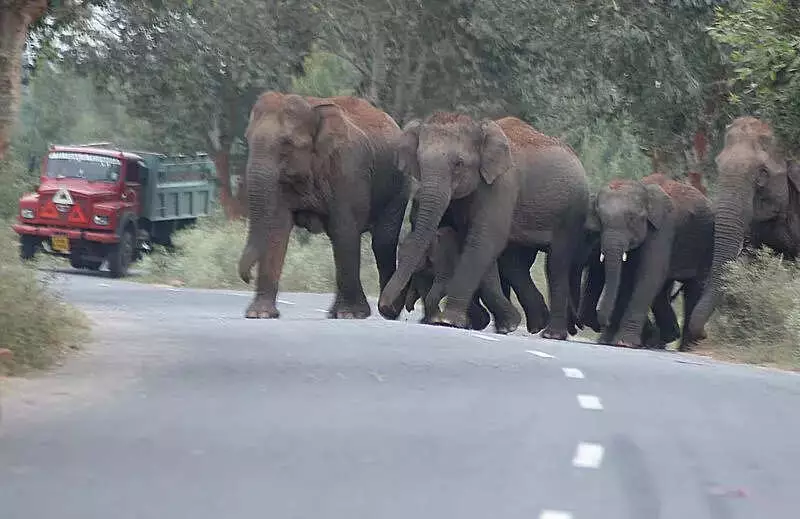
A committee appointed by the Supreme Court has raised a major alarm over the swift and steady disappearance of vital elephant corridors across India. The Central Empowered Committee (CEC), in a recent report, has revealed a shocking reality: nearly one-tenth of the country's identified elephant pathways have effectively ceased to exist.
Field Report Highlights Critical Loss
The committee's findings were part of a field inspection report submitted to the Supreme Court on January 5. The inspection was conducted at the Bannerghatta National Park (BNP) in Bengaluru, focusing on the inclusion of corridors and adjacent forest areas within the park's Eco-Sensitive Zone (ESZ). The panel's assessment was stark, noting that several corridors are no longer functional and require urgent restoration to ensure safe passage for elephants.
The CEC identified infrastructure development as the single largest threat to these crucial wildlife pathways nationwide. It strongly recommended that planning for wildlife conservation must be integrated into the blueprints of energy, transport, and other linear infrastructure projects to prevent further fragmentation.

Usage Patterns Show Both Hope and Decline
Citing the 'Elephant Corridors of India 2023' report by the Union Ministry of Environment, Forest and Climate Change (MoEFCC) and Project Elephant, the committee provided a detailed snapshot of corridor usage. There is some positive news: elephant usage has increased in roughly 40% of the corridors, indicating a growing dependence on these routes.
However, the data also paints a worrying picture. Movement has declined sharply in 29 corridors, accounting for 19% of the total. Usage remained stable in another 19%. The CEC emphasized that these corridors are not just trails but are critical for maintaining the long-term demographic and genetic health of elephant populations, preventing isolated, unsustainable herds.
Restoration is Possible, But Action is Needed Now
The report is not all doom and gloom. It points to successful restoration efforts in damaged corridors across states like Karnataka, Tamil Nadu, Uttarakhand, Kerala, and Odisha as proof that focused intervention can revive these lifelines. Stressing the need for stronger habitat connectivity, the committee called for integrating multiple networks of elephant corridors.
To secure the future, the panel advocated for periodic monitoring of corridors and elephant population estimation. "Such focused monitoring would help in securing corridors, understanding movement patterns, forecasting human–elephant conflict scenarios and implementing effective mitigation strategies," the report stated.
An interesting regional disparity was highlighted. While southern India hosts the highest density of elephant populations, it contains only 21% (32) of the country's corridors. West Bengal leads with 26 corridors (over 17%), followed by the east-central region (35% of corridors), the northeast (32%), and the northern region (12%).