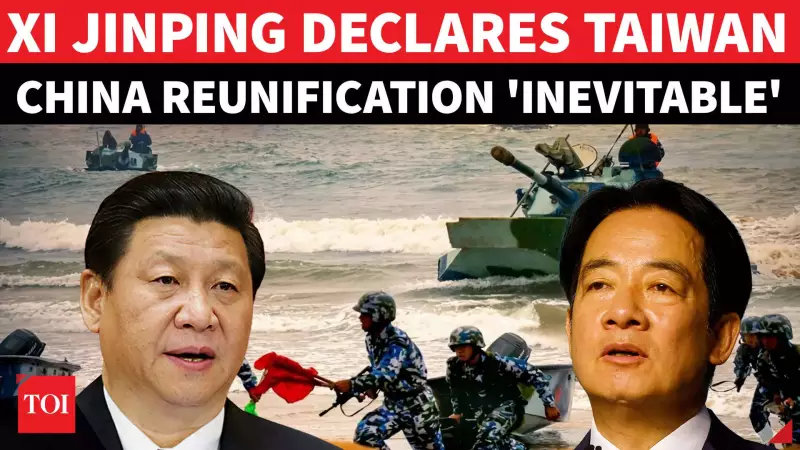
In a significant New Year's Day address that resonated across the Indo-Pacific region, Chinese President Xi Jinping delivered a firm and urgent message concerning the future of Taiwan. Speaking from Beijing on January 1, 2026, Xi positioned the unification of Taiwan with mainland China as an inevitable historical force, while also outlining Beijing's vision for a turbulent world.
The Core Message: An 'Unstoppable' Historical Trend
President Xi Jinping's speech placed the Taiwan issue at the forefront of his national and international agenda. He emphasized the deep, familial ties across the strait, stating that 'compatriots on both sides of the Taiwan Strait are connected by blood.' The Chinese leader left no room for ambiguity regarding Beijing's long-term goal, insisting that the historical trend toward what he termed 'national reunification' is ultimately 'unstoppable.'
This declaration comes against a backdrop of persistent military tensions and increased Chinese aerial and naval activity near the island, which China claims as its own territory. Xi's words are seen as a reinforcement of China's consistent policy, but their prominence in the New Year address signals a continued focus and urgency from the top leadership.
China on the World Stage: Standing on the 'Right Side of History'
Beyond the Taiwan focus, President Xi used the platform to articulate China's role in global affairs. He asserted that Beijing consistently positions itself on the 'right side of history.' In a time of rising international conflicts and uncertainty, Xi pledged that China would collaborate with all nations to foster global peace, development, and a 'shared future for humanity.'
This part of the address appears crafted to project China as a responsible and stabilizing global power, offering an alternative vision of international relations amidst ongoing turmoil in regions like Ukraine and the Middle East.
Commemorating History: China's 80th Victory Day
Reflecting on the past year, President Xi highlighted a major domestic event: China's grand commemorations for the 80th Victory Day. This event marked eight decades since the defeat of Japan and the end of World War II. The commemorations, held in Beijing, were a showcase of national pride and military might.
World leaders gathered in the Chinese capital for extensive military parades and ceremonies, which Xi described as 'majestic and powerful.' The reference serves as a reminder of China's historical narrative and its modern-day resurgence as a global power, drawing a direct line from its wartime past to its present-day geopolitical stature.
Xi Jinping's 2026 New Year address, therefore, wove together threads of national sovereignty, historical legacy, and global ambition. The unequivocal stance on Taiwan unification reaffirms a core national priority for Beijing, ensuring the issue remains central to China's domestic rhetoric and foreign policy interactions in the coming year. The speech underscores the delicate and potentially volatile balance in the Taiwan Strait, with implications for regional security and international diplomacy.