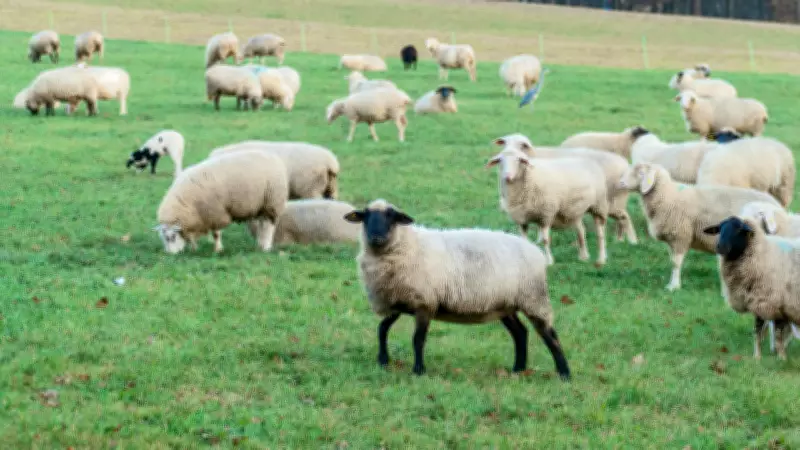
Australian Farmers Turn to Wool for Soil Restoration Amid Harsher Conditions
Across extensive rural areas of Australia, agricultural producers are confronting increasingly severe environmental challenges. Rainfall patterns have become more unpredictable, while soils are deteriorating in structure. Fields that previously yielded abundant crops are now frequently transforming into barren, dusty landscapes. Prolonged periods of drought combined with intensive farming practices have depleted organic matter from the earth, significantly reducing the land's capacity to absorb and hold moisture. For many growers, the primary objective has shifted from maximizing crop yields to simply maintaining any level of productivity on their land.
Sheep Wool Emerges as an Innovative Soil Solution
Simultaneously, sheep farmers are grappling with a distinct issue: substantial stockpiles of coarse, low-quality wool accumulating in shearing facilities. This material often holds minimal value in international textile markets, with storage or disposal expenses frequently surpassing any potential earnings. However, what was once considered agricultural waste is now being reevaluated for its potential in soil management. By applying sheep's wool to drought-impacted fields, farmers and scientists are experimenting with a straightforward method that is demonstrating measurable improvements in soil vitality.
From Waste to Protective Soil Cover
In sheep-grazing regions like New South Wales, significant quantities of wool cannot be sold profitably due to fibers being too coarse or short for use in clothing or carpets. Instead of discarding it, producers are utilizing this material as mulch or a soil amendment. The industry organization Australian Wool Innovation has funded research into novel applications for surplus wool, with soil enhancement being a key focus area, particularly where land resilience and waste reduction intersect.

When distributed over bare soil or incorporated into the surface layer, wool creates a protective covering. This layer minimizes exposure to sunlight and wind, two primary factors that accelerate moisture loss in arid environments.
Enhancing Water Retention with Wool Fibers
Wool fibers possess the ability to absorb up to double their weight in water, releasing this moisture gradually over time. Soil experts highlight that this characteristic helps maintain water availability near plant roots for extended durations. Field experiments conducted over multiple growing seasons indicate that soil treated with wool experiences reduced moisture loss from evaporation compared to untreated ground. In numerous instances, moisture levels remain elevated longer than with traditional organic mulches.
Researchers at CSIRO emphasize that improving water retention is crucial for building drought resistance. Organic amendments that retain moisture and restore structure are especially valuable in degraded soils.
Revitalizing Biological Activity in Soil
Water retention represents only one aspect of wool's benefits. It also fosters biological recovery in soil ecosystems. Healthy soil relies on microorganisms that cycle nutrients and bind soil particles together, but these organisms are often scarce in degraded land. Soil samples from plots treated with wool show noticeable increases in microbial activity within months. Agronomists interpret this as a sign of returning soil functionality. As microbial life rebounds, soil structure strengthens, erosion decreases, and roots penetrate more easily.
In some trial areas, scientists observed visible transformations after just one dry season. Soil that previously dispersed in the wind began to cohere again.
Providing Slow-Release Nutrients
Wool contains essential plant growth elements such as nitrogen, sulphur, and carbon, encapsulated within keratin, a protein that decomposes slowly. Studies demonstrate that this gradual breakdown releases nutrients steadily, reducing issues like leaching and runoff commonly associated with synthetic fertilizers. Investigators have found that wool-based amendments can perform comparably to organic fertilizers for certain crops while delivering longer-term soil advantages.

Processing Wool for Agricultural Use
Raw wool cannot be applied universally without preparation, as unprocessed fibers may clump and impede water movement if used incorrectly. To prevent this, wool is increasingly converted into pellets, granules, or blended products. These forms facilitate even distribution and mixing into soil. Some are combined with organic matter or beneficial microbes to enhance consistency and effectiveness.
Specialists note that outcomes depend on soil type, climate conditions, and application rates. Wool functions most effectively as part of a comprehensive soil management plan.
Economic and Environmental Advantages
Utilizing waste wool in agriculture presents economic opportunities by creating new markets for a low-value commodity and supporting rural processing employment. Processed wool products can be worth multiple times more than raw surplus wool. Environmental benefits are equally evident, as wool diminishes reliance on energy-intensive synthetic inputs and promotes circular farming practices. Agricultural economists assert these dual benefits are growing in importance as farmers face escalating costs and climate-related pressures.
International Interest and Future Prospects
This approach is garnering attention beyond Australia. European researchers are testing wool-based soil treatments using coarse fibers from meat and dairy sheep. Preliminary results from trials in Poland, Italy, and Germany indicate enhanced moisture retention and more robust crop growth. Scientists involved state that Australia's research provides valuable data for broader adoption. For Australian farmers enduring prolonged droughts and declining soil quality, wool offers a practical, research-supported tool. By transforming an overlooked by-product into a soil amendment, producers are rehabilitating land once deemed irrecoverable.