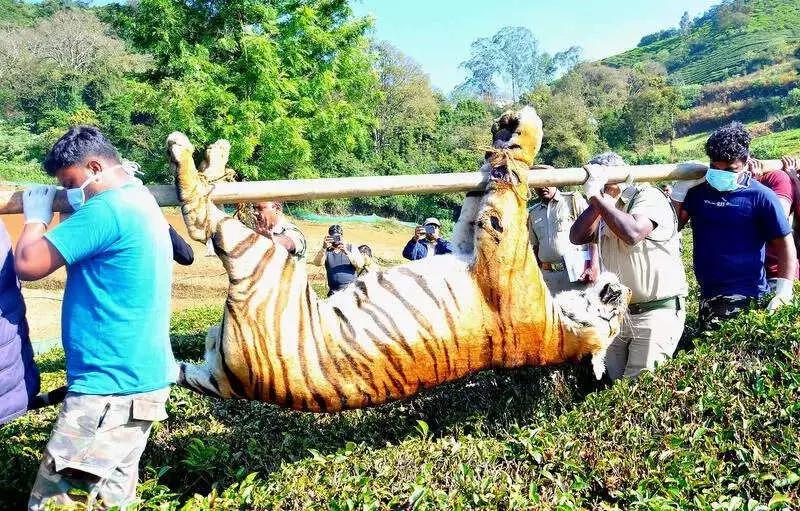
Injured Tiger Succumbs in Tea Estate, Postmortem Reveals Fatal Fight
A tragic incident unfolded in the Nilgiris district this week, as a male tiger, approximately seven years old, was found dead inside a tea estate. The location was Porthi Village in Udhagamandalam, and the grim discovery was made by forest department officials on Monday morning.
The big cat had sustained serious injuries, which officials confirmed were the result of an in-fighting incident, likely with another tiger. This natural but often brutal behaviour proved fatal for the animal.
Monitoring and Final Moments
The forest department had been tracking the injured tiger for two days prior to its death. On January 3, the animal was first spotted with visible wounds amidst bushes in the tea estate after local residents raised the alarm.

Responding swiftly, the department deployed thermal drones to monitor the tiger's movements and condition without causing further distress. The surveillance revealed that the tiger moved a few hundred meters deeper into the plantation on the same day.
However, by Monday morning, the monitoring team observed that the tiger had stopped showing any signs of movement. Frontline forest staff then cautiously approached the location and confirmed the unfortunate news of its death.
Postmortem and Official Statement
Following the standard protocol set by the National Tiger Conservation Authority (NTCA), a detailed postmortem examination was conducted on the carcass immediately after its recovery.
The veterinary report provided a clear picture of the tiger's fatal injuries. It revealed that the animal had suffered fractures in two of its four limbs. These injuries were consistent with a violent altercation with another tiger.
"Tigers suffer such injuries while fighting with another tiger, which is a natural process," explained a forest department official. "The forest department decided not to capture the animal to treat it, as the injury occurred due to natural causes."
This decision highlights the department's policy of minimal intervention in natural wildlife behaviour, unless human-induced factors are involved. After the postmortem procedure was completed, the tiger's carcass was cremated as per guidelines.
Reflections on Wildlife Conservation
This incident underscores the harsh realities of life in the wild, even for apex predators like tigers. Territorial disputes and mating rights often lead to fierce combats between males, which can sometimes turn deadly.
The use of technology like thermal drones by the Tamil Nadu Forest Department demonstrates a modern approach to wildlife monitoring, allowing officials to observe critically injured animals from a safe distance and make informed decisions.
While the death of any tiger is a loss for the ecosystem, officials maintain that such events are part of the natural cycle. The focus remains on protecting tiger habitats from human encroachment and poaching, which pose far greater threats to their population than natural intra-species conflicts.