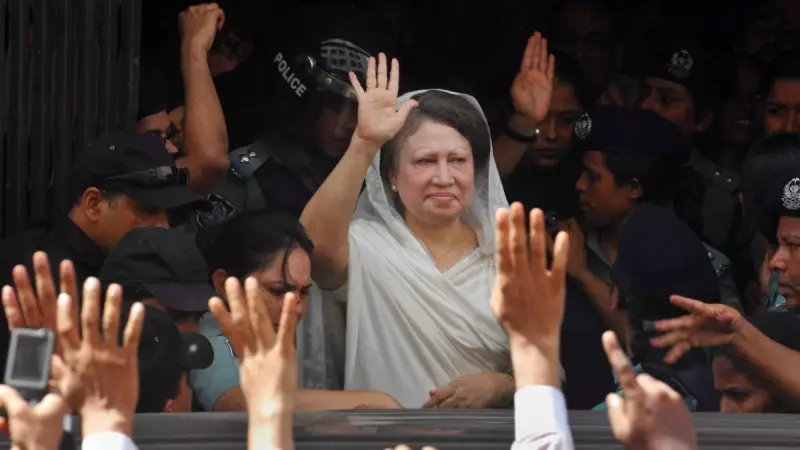
Bangladesh has plunged into a period of official grief following the passing of one of its most formidable political figures. The nation will observe a three-day state mourning for former Prime Minister and Bangladesh Nationalist Party (BNP) chairperson, Begum Khaleda Zia, who died on Monday at the age of 79. Her final rites are scheduled to be held on Wednesday, December 31.
A Nation in Mourning: Official Protocols and Funeral Arrangements
The government of Bangladesh, led by Prime Minister Sheikh Hasina, swiftly announced the official period of mourning to honor the former head of government. During the three-day state mourning, which began on Monday, the national flag will fly at half-mast across all government, semi-government, and autonomous institutions, as well as at Bangladeshi missions abroad.
Khaleda Zia's body is currently at the Combined Military Hospital (CMH) in Dhaka. According to the detailed schedule released by authorities, her body will be taken to the National Mosque, Baitul Mukarram, for a public janaza (funeral prayer) on Wednesday morning. Following this, her mortal remains will be transported to the Firoza Begum Mosque in the capital's Gulshan area for another prayer session.

The final journey will then proceed to the Bangabandhu Memorial Museum in Dhanmondi, where members of the public will have the opportunity to pay their last respects. Her burial will take place at the Banani Graveyard in Dhaka, where she will be laid to rest beside the grave of her husband, former President Ziaur Rahman.
The Legacy of a Political Powerhouse
Khaleda Zia's death marks the end of an era in Bangladeshi politics. She served as the Prime Minister of Bangladesh for three terms – from 1991 to 1996, and again from 2001 to 2006. Her political journey was deeply intertwined with the nation's turbulent democratic history.
As the chairperson of the Bangladesh Nationalist Party (BNP), she was the central figure in the opposition for many years. Her political rivalry with current Prime Minister Sheikh Hasina, leader of the Awami League, defined the country's political landscape for decades. This intense rivalry, often dubbed a battle between "two begums," was a dominant theme in Bangladesh's governance and electoral politics.
In her later years, Khaleda Zia faced significant legal and health challenges. She was convicted in several corruption cases, which her party and supporters decried as politically motivated. Since 2020, she had been receiving medical treatment primarily at home under a government suspension of her jail sentence, following appeals from her family on health grounds.
Reactions and the Path Forward
The announcement of her death and the subsequent state mourning has triggered a wave of reactions both domestically and internationally. While her supporters and party members mourn the loss of their iconic leader, the government's declaration of state mourning is seen as a formal recognition of her stature as a former head of government.
Her passing leaves a significant vacuum in the leadership of the BNP, which is already navigating a challenging political environment. The party must now confront the future without its most recognizable and influential figure at the helm. The coming days, leading up to and following the funeral, will be closely watched for political signals and the potential reshaping of opposition dynamics in Bangladesh.
The elaborate state-managed funeral proceedings underscore the complex legacy Khaleda Zia leaves behind – that of a respected former prime minister accorded official honors, and simultaneously, a controversial political opponent whose career was marked by both triumph and tribulation. As Bangladesh observes this period of mourning, the nation reflects on a chapter of its history personified by a leader whose influence will be debated and remembered for years to come.