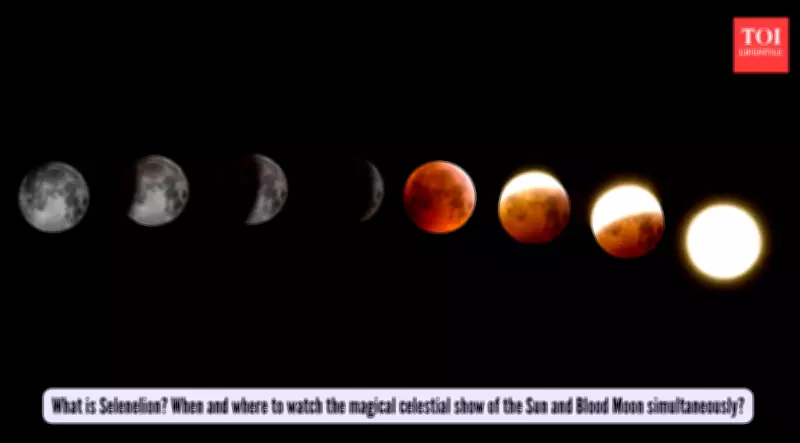
Rare Celestial Event: Selenelion to Showcase Blood Moon and Sun Simultaneously
Skywatchers are in for a breathtaking treat on March 3, 2026, as a total lunar eclipse transforms the Moon into a striking "Blood Moon"—a glowing red orb caused by the perfect alignment of the Sun, Earth, and Moon. This event is not just another eclipse; it features the rare phenomenon known as selenelion, where both the Sun and the eclipsed Moon become visible above the horizon at the same time, defying ordinary geometric expectations.
What Exactly Is a Selenelion?
A selenelion occurs during a total lunar eclipse when observers can spot the Sun and the eclipsed Moon simultaneously in opposite parts of the sky. Normally, this seems impossible because the Earth sits directly between the Sun and Moon in a straight line during an eclipse, meaning one should disappear as the other appears. However, on March 3, 2026, early risers in eastern North America—including parts of the eastern United States and Canada—will experience this "impossible" view for about one to three minutes around sunrise.
Viewers in these regions might catch the rising Sun in the east and the Blood Moon setting in the west, thanks to a special optical quirk. This brief window offers a unique celestial show that blends dawn and dusk in a single glance.

The Science Behind the Selenelion Illusion
Why does this happen? Earth's atmosphere acts like a giant lens, bending light rays through a process called refraction. This refraction lifts the images of the Sun and Moon higher than their actual positions, keeping them visible even when they have technically dipped below the horizon. For a short period—typically two to nine minutes during sunrise or sunset—both celestial bodies remain in view due to this atmospheric effect.
It's important to note that this is an illusion; no actual laws of geometry are broken. As explained by sources like Space.com, atmospheric refraction makes objects appear higher, turning what should be hidden into a lingering glow. During the eclipse's totality, the Moon moves deep into Earth's shadow, glowing red because our atmosphere scatters blue light while allowing red rays to pass through and bounce off the lunar surface.
Why the 2026 Annular Lunar Eclipse Is Special
This event stands out because its totality aligns perfectly with dawn or dusk for millions of people worldwide, maximizing visibility. In India, the eclipse reaches its maximum at 5:04 PM IST, casting the Moon in dark red or orange hues. Unlike solar eclipses, no eye protection is required for safe viewing, making it accessible to all.
The penumbral phase begins around 4:50 a.m. EST, with totality lasting from 6:04 to 7:02 a.m. EST and peaking at 6:33 a.m. EST. According to EclipseWise, the eclipse peaks at 11:34 UT (approximately 5:04 p.m. IST), with the Moon appearing in the constellation Leo. Beyond North America, the full eclipse is visible in the western U.S., Pacific regions, Australia, and East Asia.
Where to Witness the Selenelion
Eastern North America offers the prime viewing opportunity for the selenelion, thanks to optimal timing at sunrise. To make the most of this celestial spectacle, follow these tips:
- Find a location with clear eastern and western horizons to see both the Sun and Moon.
- Avoid city lights to reduce light pollution and enhance visibility.
- Use binoculars to amplify the coppery details on the Blood Moon.
- Check resources like timeanddate.com for local timings, as weather conditions can affect viewing.
- In India, focus on the evening peak around 5:04 PM IST for the best experience.
This rare alignment promises a magical moment for astronomy enthusiasts and casual observers alike, blending science and wonder in the night sky.