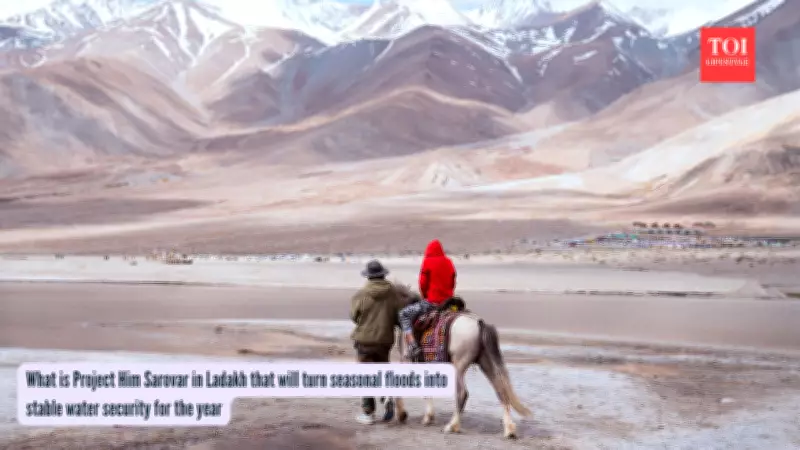
In the high-altitude cold desert of Ladakh, water is not a luxury; it is a lifeline. The region receives minimal rainfall and depends almost entirely on glaciers and mountain snowmelt, which arrives in a short, intense rush each year and then vanishes just as quickly. In many villages, water that could sustain fields and homes instead flows past, unused, while people face prolonged water shortages months later.
Now, Ladakh is wagering on a quiet but ambitious plan, dependent on a wave of small, village-sized reservoirs that can capture and store snowmelt, rainwater, and glacial runoff so that people have water not just in summer, but across the year. This initiative is called Project Him Sarovar.
What is Project Him Sarovar?
Under Project Him Sarovar, the Ladakh administration plans to build 100 water bodies within one year. Half of them are already underway in the first phase, with 30 in Leh and 20 in Kargil, according to the Ladakh government rollout. Each reservoir is roughly 40 metres by 30 metres and about 2 metres deep, designed to trap rainwater, snowmelt, and glacial melt that would otherwise wash away downstream.

The project aims at scientific snow harvesting and the creation of water bodies to tackle scarcity in a fragile ecosystem where water is not merely a resource but a lifeline for the people. The Lieutenant Governor, Vinai Kumar Saxena, has described Him Sarovar as a historic and decisive intervention, stressing that the structures will help conserve both rainwater and annual snowmelt for agriculture and local livelihoods.
How a Village Reservoir Was Built in Weeks
The first Him Sarovar reservoir has already come up in Stok village, near Leh, and is now fully operational. The site was a heavily silted natural depression that local departments cleaned, dredged, stone-pitched, and reinforced with retaining walls, with active participation from residents.
The project team completed the 1,824-square-metre basin in about three weeks, starting from the first site visit on March 26. On April 17, glacier water was released into it for the first time.
Why This Approach Is Different
Ladakh is no stranger to water-storage ideas. For years, communities have used artificial glaciers and ice stupas, vertical ice structures that slowly melt in spring, to stretch water availability into the growing season. Yet most of these remain small-scale, local experiments, often limited to a few villages or fields. Project Him Sarovar, in contrast, is a government-led, large-scale initiative aiming to create 100 reservoirs in a single year, with standardized designs and rapid implementation. This approach promises to bring water security to a much larger population across the region.