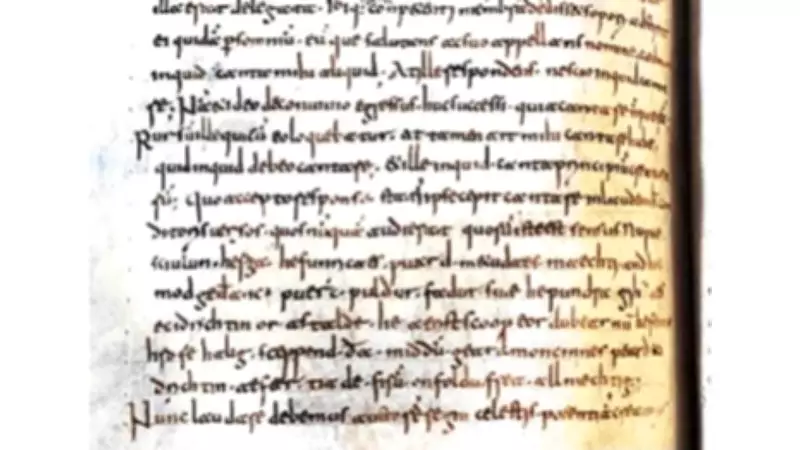
Researchers in Ireland have made a remarkable discovery: the oldest surviving English poem, hidden in a medieval manuscript found in a Roman library. The team from Trinity College Dublin was examining digitized pages of a 9th-century copy of Bede's 'Ecclesiastical History of the English People' when they spotted the poem 'Caedmon's Hymn' within the main Latin text.
A Surprising Find
Elisabetta Magnanti, a research fellow at Trinity College Dublin's school of English, described the moment: 'We were extremely surprised. We were speechless. We couldn't believe our eyes when we first saw that.' She added that the poem's placement within the main body of Latin text was extraordinary.
The Poem's Origins
Composed in Old English by a Northumbrian agricultural worker in the 7th century, 'Caedmon's Hymn' is considered the beginning of English literature. It appears in some copies of Bede's history, which was one of the most widely reproduced texts from the Middle Ages, with almost 200 manuscripts. Mark Faulkner, an associate professor of medieval literature at Trinity, noted that the newly discovered manuscript is one of the oldest, dating from the 9th century.

Significance of the Discovery
Two earlier copies contain the poem, but only as afterthoughts—translated from Latin and added in margins or appended, not within the main text. This new finding shows the poem was integrated into the body of the work three centuries earlier than previously known. 'Prior to the discovery of the Rome manuscript, the earliest one was from the 12th century. So this is three centuries earlier than that,' Faulkner said.
Journey of the Manuscript
The manuscript was transcribed by monks at the Benedictine abbey of Nonantola near Modena, Italy, one of the most important transcription centers in the Middle Ages. In the 17th century, as the abbey declined, its manuscripts were moved to Rome, then to the Vatican, and eventually to a church. Some texts went missing, only to reappear in the 19th century with international collectors.
Italy's culture ministry searched for the missing manuscripts, buying this copy from rare bookseller H.P. Kraus in 1972. Since then, it has remained in Rome's National Central Library. Magnanti, who had studied Bede's history for over four years, knew the book was listed in the library's catalogue. After emailing the library, she received digital images three months later, leading to the discovery.