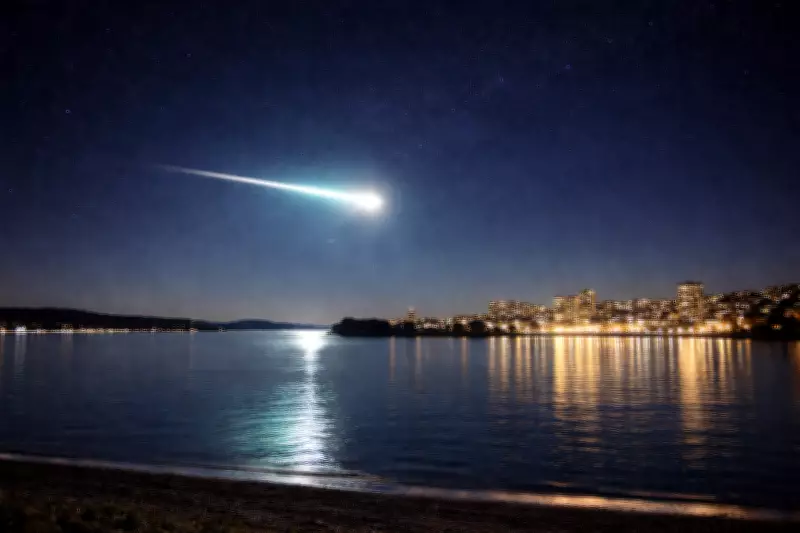
Mysterious Light Streak Illuminates Wellington Sky: Meteor or Space Debris?
A brilliant streak of light briefly illuminated the night sky above Wellington, New Zealand, on January 30, capturing the attention of residents and online viewers across the globe. The fleeting phenomenon was recorded by a fixed webcam at the Heretaunga Boating Club, where the luminous trail appeared reflected on the harbour waters before vanishing from sight.
Webcam Footage Captures the Enigmatic Event
The footage, which circulated rapidly after being shared online, shows a sharp, luminous trail moving across the sky in mere seconds. It appeared significantly brighter than typical aircraft lights and lacked the characteristic blinking patterns associated with planes or helicopters. The reflection in the harbour added to the impression of its intensity, though the entire event concluded almost as soon as it began.
Observers in and around Wellington reported witnessing the light at approximately the same time. Descriptions varied, with some calling it a sudden flash and others noting it as a slow, deliberate streak. Notably, no accompanying sound was reported, and there were no immediate accounts of debris reaching the ground.

Uncertain Origins: Natural Phenomenon or Human-Made Object?
According to reporting by the BBC, the source of the light remains unconfirmed, though preliminary assessments suggest it could have been a meteor or a piece of space debris re-entering Earth's atmosphere. Such events are not uncommon, but their sudden appearance and visibility often leave room for uncertainty, especially when they occur over populated areas and are recorded from multiple angles.
Meteor Hypothesis: The light may have been caused by a meteor burning up as it entered the atmosphere. These natural objects, often no larger than a pebble, can produce striking visual displays due to rapid heating from atmospheric friction. Most disintegrate high above the Earth's surface, leaving no trace behind.
Space Debris Possibility: Alternatively, the phenomenon could be attributed to space debris. In recent decades, the volume of human-made objects in orbit has grown steadily. Old satellites, fragments from collisions, and discarded rocket parts occasionally fall back toward Earth, creating visual effects that closely resemble meteors.
The Growing Challenge of Orbital Congestion
The European Space Agency highlights that over sixty years of space activity have resulted in a crowded orbital environment. More than 6,000 launches have placed tens of thousands of tracked objects into space, with only a small proportion remaining operational. The rest continue to orbit the planet, gradually losing altitude.
Collectively, this hardware represents thousands of tonnes of material. While most pieces burn up harmlessly upon re-entry, some survive longer than expected, depending on their size, composition, and structural integrity.
Distinguishing Between Light Trails: A Ground-Level Challenge
Meteors typically move quickly and follow predictable paths based on their entry angle into the atmosphere. In contrast, space debris can behave less consistently. Its shape, rotation, and material composition can all influence how it breaks apart, sometimes producing longer-lasting or uneven light trails.
From the ground, these differences are not always easy to distinguish. A brief video clip, even a clear one, rarely provides sufficient information on its own to definitively identify the object's origin.
The mysterious light over Wellington serves as a reminder of the dynamic interactions between our planet and the space environment, whether natural or human-made. As orbital traffic increases, such sightings may become more frequent, continuing to captivate and puzzle observers worldwide.