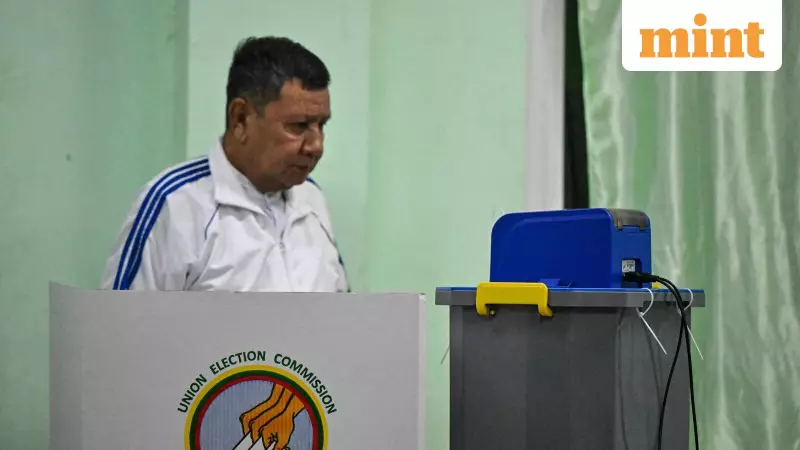
Myanmar, under military rule and engulfed in a severe civil war, proceeded with a phased general election on Sunday. This marks the country's first national poll in five years and the inaugural one since the army seized power in a 2021 coup, toppling the democratically elected government of Aung San Suu Kyi.
A Contested Vote in a Nation Under Siege
The military junta, which has governed since the takeover, has framed the election as a pivotal moment for political and economic renewal in the impoverished Southeast Asian nation. Voting commenced in 102 of Myanmar's 330 townships on Sunday, with subsequent rounds scheduled for January 11 and January 25, 2024. Final results are anticipated by late January.
Polling stations, set up in locations like high schools and government buildings in Yangon and the capital Naypyitaw, saw a heavy security presence. Armed guards were stationed outside, and military trucks patrolled streets, reflecting the tense atmosphere. For the first time in Myanmar's electoral history, electronic voting machines were deployed.

An Election Without Key Players
The electoral landscape is starkly different from the 2020 vote. Nobel Peace Prize laureate Aung San Suu Kyi, the 80-year-old former leader, is not participating as she serves a 27-year prison sentence on charges widely condemned as politically motivated. Her party, the National League for Democracy (NLD), which won a landslide in 2020, was dissolved in 2023 after refusing to register under the junta's new rules.
While over 4,800 candidates from 57 parties are competing for seats, only six are running nationwide with any real chance of gaining influence. Many opposition parties have refused to register or participate under what they deem unfair conditions, and resistance groups have called for a complete voter boycott. Analysts highlight a critical lack of choice, noting that 73% of voters in 2020 supported parties that no longer exist.
International Condemnation and Domestic Repression
The election has been widely derided by critics, including the United Nations, several Western nations, and human rights groups. They assert the process is neither free, fair, nor credible, designed solely to lend a facade of legitimacy to military rule. Critics argue the expected victory of the military-backed Union Solidarity and Development Party will make any nominal shift to civilian rule an illusion.
Mobilizing opposition is exceptionally difficult under the junta's repression. A new Election Protection Law imposes harsh penalties for criticising the polls. According to the Assistance Association for Political Prisoners, more than 22,000 people are detained for political offenses, and security forces have killed over 7,600 civilians since the 2021 takeover. The UN reports that the ensuing civil war has displaced more than 3.6 million people.
UN Human Rights Chief Volker Türk stated that Myanmar is experiencing intensified violence and intimidation, with no conditions for free expression or peaceful assembly. Despite vows from armed resistance groups to disrupt the election, no major actions were reported on the first polling day.
Western nations maintain sanctions on Myanmar's generals, while some neighbouring countries like China, India, and Thailand may use the election's occurrence to justify continued engagement, citing stability. Ultimately, both the military and its opponents believe power will remain with Senior General Min Aung Hlaing, the architect of the 2021 power seizure.