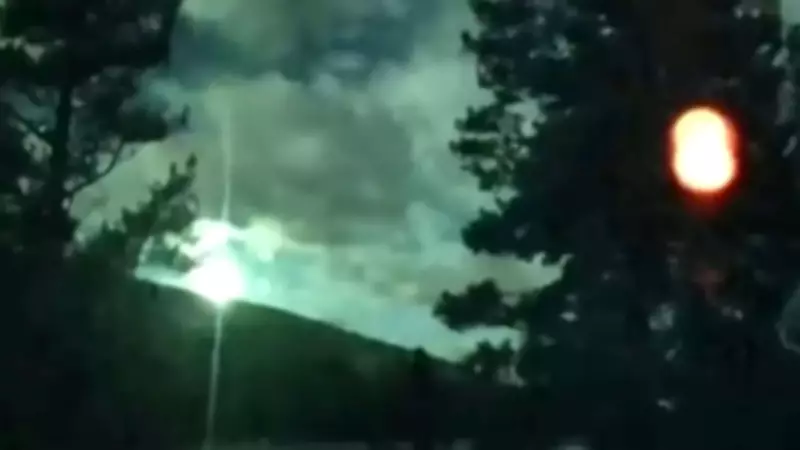
Meteor Fireball Confirmed Over Pacific Northwest, NASA Reports
Residents across Western Washington and British Columbia were treated to a stunning celestial display on Tuesday night, as a bright fireball streaked across the sky, followed by a distinct sonic boom. Reports have now confirmed that this spectacular event was indeed a meteor, traveling slightly east of north at an incredible speed of approximately 33 kilometers per second, or about 119,000 kilometers per hour.
Public Confusion and Expert Analysis
Several witnesses, unsure whether they were witnessing an accident, earthquake, or something else entirely, called local police departments to report the unusual sight. According to Robert Lunsford with the American Meteor Society, meteors are typically only the size of a pea, but their immense velocity makes them highly visible in the night sky. The flash observed on Tuesday was determined to be too rapid to be human-made space debris.
"A meteor the size of a softball can produce a flash as bright as the full moon and qualify as a fireball," Lunsford stated in a report by CBC News. "Therefore, this object was still relatively small, but capable of producing an impressive sight in the sky."

The Science Behind the Sonic Boom and NASA Confirmation
The brilliant flash was quickly followed by a sonic boom, a key indicator of the meteor's extreme velocity. A sonic boom occurs when an object travels through the upper atmosphere so swiftly that it compresses the air ahead of it, generating intense heat and sound waves.
In an official statement to the Canadian Press, NASA confirmed reports of a meteor over the Pacific Northwest shortly after 9 p.m. local time on Tuesday. The space agency detailed that the meteor disintegrated at an altitude of about 65 kilometers above Greenmantle Mountain, located within British Columbia's scenic Garibaldi Provincial Park.
Expert Insights from University of British Columbia
University of British Columbia astronomy professor Brett Gladman provided further scientific context, explaining that initial data suggests the fireball was caused by the natural entry of a rocky asteroid fragment into Earth's upper atmosphere. Gladman estimated the fragment to be approximately 10 centimeters in size, though he later noted it could potentially be as large as 100 centimeters.
"The visible meteor is the glowing atmosphere heated by rock's passage and the audible boom is because the speed of the object is faster than the speed of sound (like the supersonic boom related to fast jet planes)," Gladman elaborated, clarifying the dual phenomena observed by thousands of residents.
This natural event serves as a vivid reminder of the dynamic processes occurring in our solar system, captivating skywatchers and scientists alike with its brief but brilliant appearance.