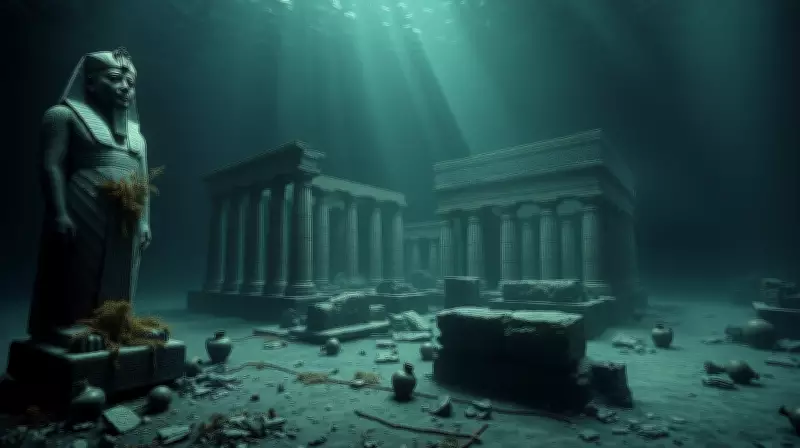
Roughly 7 kilometres off the coast of modern Egypt, beneath the shallow waters of the Bay of Aboukir, lies a city that most of the world has forgotten existed. Known in antiquity as Thonis-Heracleion, it was for centuries the largest port on Egypt's Mediterranean coast, the gateway through which merchants, mercenaries, and pilgrims passed before reaching the Nile delta. Then, sometime around the second century BC, a catastrophic combination of rising sea levels, earthquakes, and tidal waves triggered a process of land liquefaction that swallowed a 110-square-kilometre section of the Nile delta whole, taking the city with it. It was rediscovered only in 2000 by French marine archaeologist Franck Goddio and his team at the European Institute for Underwater Archaeology (IEASM). In September 2023, that same team announced its most remarkable finds yet: the treasury of a great temple, a previously unknown Greek shrine, and objects that had lain undisturbed beneath layers of hard clay for more than two millennia.
What Thonis-Heracleion Was and Why It Mattered to Ancient Egypt
Before Alexandria existed, Thonis-Heracleion was the place where Egypt met the Mediterranean world. Founded around 2,500 years ago near the mouth of the Canopic Branch of the Nile, the largest and most navigable branch of the river in antiquity, the city served as the mandatory port of entry for all ships arriving from the Greek world. Every merchant vessel carrying olive oil, wine, silver, and ceramics into Egypt passed through it. Every Egyptian export heading outward did the same.
The city was eventually surpassed by Alexandria, founded by Alexander the Great in 331 BCE, and was lost to a combination of rising sea levels, earthquakes, and tsunamis, disappearing beneath the waves along with its temples, statues, and treasures. Since its rediscovery, the site has yielded extraordinary finds. Excavations have yielded 64 well-preserved ships, 700 anchors, gold coins, and colossal statues standing at an impressive five metres in height, as well as the remains of a vast temple dedicated to the god Amun-Gereb.

The Temple of Amun and the Treasure Found Buried Beneath Its Collapsed Stones
The centrepiece of the 2023 discoveries was the treasury of the great Temple of Amun, a structure of enormous religious and political significance in ancient Egyptian life. This was the temple to the god Amun, where pharaohs came to receive from the supreme god of the ancient Egyptian pantheon the titles of their power as universal kings. It was not a peripheral sanctuary but one of the most important ceremonial sites in the city, closely bound to the legitimacy of royal authority.
The temple collapsed into the city's south canal during the catastrophic seismic event of the mid-second century BC. Its massive stone blocks fell into the water and were buried under approximately three metres of hard clay, a layer that, despite being produced by catastrophe, turned out to function as extraordinary preservation. Precious objects belonging to the temple treasury were unearthed from beneath those fallen blocks, including silver ritual instruments, gold jewellery, and fragile alabaster containers for perfumes and unguents.
Among the gold objects recovered were jewellery pieces and a Djed pillar, the ancient Egyptian symbol of stability, fashioned from lapis lazuli, dating to the 5th century BC. The silver items included ritual dishes used for libations, offerings of liquid poured out to honour the gods. Silver was considered exceptionally precious in ancient Egypt, rarer and more highly valued than in many other ancient cultures, which makes its presence in the temple treasury a marker of the sanctuary's considerable wealth and status.
The Underground Wooden Structures Found Beneath the Temple Floor
Alongside the treasury objects, the excavation produced a structurally significant discovery beneath the temple itself. Archaeological excavations revealed, metres deep under the area of the temple, underground structures supported by very well-preserved wooden posts and beams dating from the 5th century BC. These predate the temple as it stood when it collapsed, suggesting the site had an earlier phase of construction or occupation that predates what was previously understood.

The survival of wooden material underwater for more than 2,500 years is itself remarkable. Wood typically degrades rapidly in most environments, but the thick anaerobic clay that has blanketed much of Thonis-Heracleion has preserved organic materials with unusual fidelity. The wooden structures will be the subject of ongoing analysis to determine their precise function and relationship to the temple above them.
The Greek Sanctuary of Aphrodite Discovered in Egypt's Lost City
One of the most historically illuminating finds of the 2023 mission was not from the Amun temple itself but from a sanctuary discovered just to its east, a shrine to the Greek goddess Aphrodite. East of the Temple of Amun-Gereb, the team discovered a Greek sanctuary devoted to the goddess Aphrodite, where imported bronze and ceramic objects were unearthed. It illustrates that the Greeks, who were allowed to trade and settle in the city during the time of the Pharaohs of the Saïte dynasty (664–525 BCE), had local sanctuaries to their own gods.
This find adds a meaningful layer to the understanding of who actually lived and worked in Thonis-Heracleion during its most active centuries. The city was not exclusively Egyptian it was a genuinely cosmopolitan trading hub where Greek merchants and soldiers maintained their own religious practices alongside the Egyptian majority. Among the bronze objects retrieved from the Aphrodite sanctuary was a delicate duck-shaped pourer, a finely crafted vessel from the 4th century BC that speaks to the sophistication of the Greek artisans who worked in or traded with the city. A votive hand and an offering left at the sanctuary, likely from Cyprus, were also recovered from the sediment.
Greek Mercenaries at the Mouth of the Nile and What Their Weapons Reveal
The presence of Greeks in Thonis-Heracleion was not limited to merchants and traders. The presence of Greek mercenaries is also documented by numerous discoveries of Greek weapons. They were defending the access to the kingdom at the mouth of the Canopic Branch of the Nile, the largest and the best navigable one in antiquity. The Saïte pharaohs of the 7th and 6th centuries BC are known from historical sources to have employed Greek mercenaries as a professional military force a practice that gave Greeks both economic foothold and cultural influence in Egypt well before Alexander's conquest. The weapons found at the site provide direct physical corroboration of what had previously been known only from ancient texts.
New Geophysical Technology That Made These Discoveries Possible
A significant reason these finds were possible at all is a suite of new geophysical prospecting technologies that the IEASM team has developed and deployed over recent missions. The use of new geophysical prospecting technologies, which make it possible to detect buried chambers and objects under thick clay layers, aided in the finds. Traditional underwater archaeology relies heavily on visual survey and direct excavation methods that are effective but slow and necessarily limited in scope when the target is buried under metres of compressed sediment.
The new tools allow the team to map subsurface cavities and detect metallic and organic objects before any physical excavation takes place, dramatically improving the efficiency and precision of the work. This is particularly important at Thonis-Heracleion, where the city's remains are distributed across a vast underwater area and are buried at varying depths under clay that is, in many places, exceptionally hard to penetrate.