

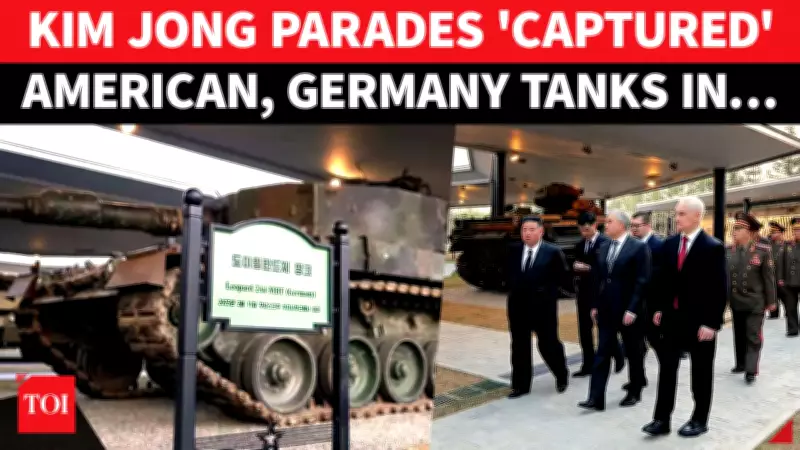
North Korean leader Kim Jong Un has showcased captured NATO tanks, including the M1 Abrams and Leopard 2, in a rare military exhibition in Pyongyang. The display sends a defiant message to the West, highlighting Pyongyang's acquisition of advanced Western battlefield hardware allegedly obtained during fighting linked to the Kursk front.
Details of the Exhibition
Dramatic images released by state media show the tanks on display, with North Korean soldiers and officials examining the vehicles. The exhibition is seen as a propaganda move to demonstrate the regime's military prowess and its ability to acquire and study advanced foreign weaponry.
Implications for North Korea's Military Doctrine
Analysts warn that the possession of these tanks could significantly reshape North Korea's anti-armour doctrine and military technology evolution. The Korean People's Army (KPA) now has direct access to study the design, armor, and systems of some of the most advanced main battle tanks in the world.

The M1 Abrams, used by the United States and several allies, and the German-made Leopard 2 are among the most formidable tanks in service. Their capture and display suggest that North Korea may be able to reverse-engineer technologies or develop countermeasures.
Geopolitical Context
The exhibition comes amid heightened tensions on the Korean Peninsula and ongoing conflicts involving NATO and allied forces. The display of captured hardware is a classic propaganda tactic used by North Korea to project strength and defiance against international sanctions and military pressure.
Experts believe that the acquisition of these tanks likely occurred through third-party transfers or battlefield captures in conflicts where North Korea has been involved or supported allied forces. The exact circumstances remain unclear, but the exhibition underscores the regime's ability to obtain Western military technology despite stringent sanctions.
Reactions and Analysis
International analysts have expressed concern over the potential for technology leakage and the impact on regional military balances. The KPA's ability to study these tanks could lead to improvements in North Korea's own armored vehicles and anti-tank weapons.
The exhibition also serves as a warning to South Korea and the United States, who rely heavily on advanced armor in their defense strategies. North Korea's growing familiarity with Western tank designs could necessitate changes in allied tactics and equipment.
In conclusion, Kim Jong Un's display of captured NATO tanks is a calculated move to showcase military capability and defiance. It raises important questions about the flow of military technology and the evolving nature of North Korea's armed forces.






