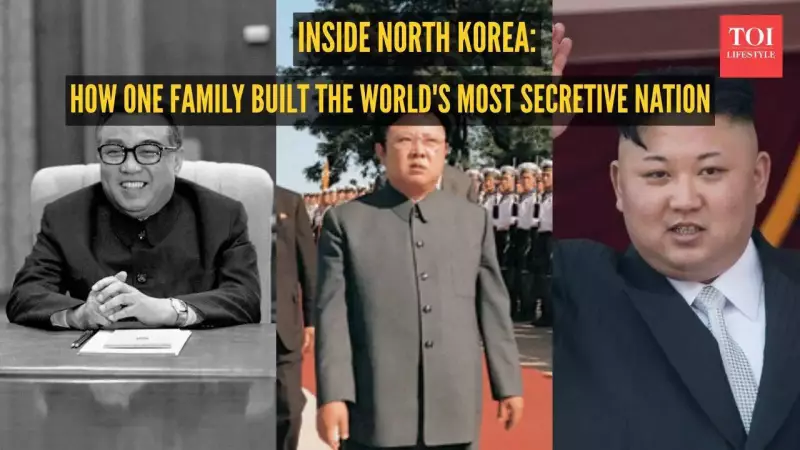
In our interconnected world, one nation stands apart in its silence and seclusion: the Democratic People's Republic of Korea, or North Korea. Roughly the size of the US state of Mississippi, this totalitarian state, bordered by China, Russia, South Korea, and Japan, has been ruled by a single family for over seven decades. While its southern neighbour thrives as a global cultural hub, the very thought of crossing the heavily fortified border into the North evokes fear. For its citizens, a life without free internet, international contact, or the right to travel is a stark reality, a system maintained through intense surveillance and brutal punishment. But how did this isolated nation come to be? The story begins with the end of a world war.
The Birth of a Divided Peninsula
From 1910 to 1945, Korea was under Japanese rule. The conclusion of World War II led to the peninsula's division along the 38th parallel, creating a Soviet-backed North and an American-backed South. In the ensuing years, Kim Il Sung, grandfather to the current leader, rose to power in the North. Born in 1912 near Pyongyang, he fled to Manchuria, joined anti-Japanese guerrillas and the Chinese Communist Party, and later, under pressure, moved to the Soviet Union in 1941. There, he served in the Red Army and started a family.
After the war, Kim Il Sung returned to Korea with Soviet support. In 1948, he established the Democratic People's Republic of Korea (DPRK). The division forced families to choose sides. In June 1950, Kim launched an attack on the South to reunify the peninsula, capturing Seoul. The devastating Korean War lasted three years, involved American forces supporting the South, and resulted in approximately 4 million deaths on both sides before ending in a stalemate.

Solidifying the Kim Dynasty and the Juche Ideology
Over the 1950s and 60s, Kim Il Sung entrenched his power, promoting the ideology of 'Juche' or self-reliance. This philosophy became the cornerstone for one of the world's most secretive and controlled regimes. He served as Premier until 1972 and then as President until his death in 1994, ruling for over 50 years and being elevated to a god-like status within the country.
His son, Kim Jong Il, succeeded him, ruling with an equally firm grip. This era saw a significant strengthening of the military and the pursuit of nuclear capabilities. Public dissent remains virtually non-existent, a result of both state-engineered devotion and the pervasive fear of the notorious prison camps, from where few return alive.
The Modern Era: Kim Jong Un and a Glimpse of Change
Following Kim Jong Il's declining health after a 2008 stroke, his third son, Kim Jong Un, took power after his father's death in 2011. His sister, Kim Yo Jong, is a key political influencer and the second most powerful figure in the regime. Kim Jong Un's early rule was marked by global shock over the purging and assassination of family members, including his half-brother Kim Jong Nam.
However, he has also shown a subtle shift from his predecessors' outright hostility towards the United States. His regime has occasionally allowed international and American journalists into the country, offering rare glimpses beyond the military parades. Visitors often report seeing the human side of North Korea—children at the beach, young people bowling, and citizens going about their daily lives. As Dai Sil Kim-Gibson, who migrated south after the war, told National Geographic, the people were "lovely, nice, intelligent, laughing, people with a lot of energies."
As Kim Jong Un continues his rule as Supreme Leader, recent appearances of his young daughter, Kim Ju Ae, at major military events and state functions have sparked widespread speculation that she is being groomed as the potential fourth-generation successor to the Kim dynasty.