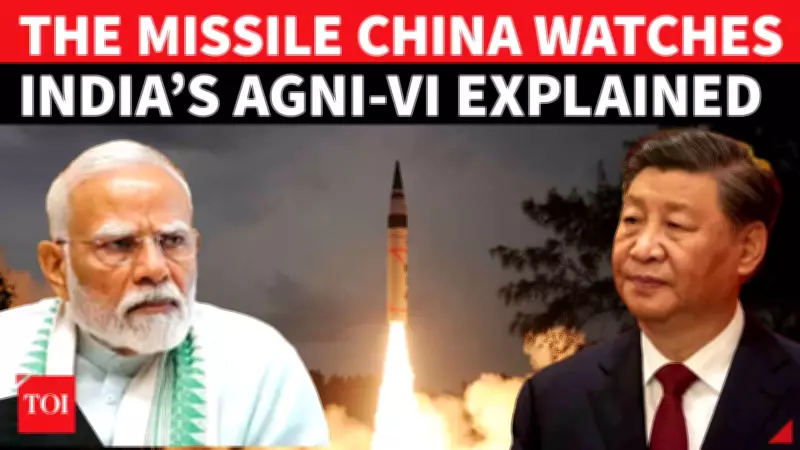
India's Agni missile programme has evolved from a Cold War-era technology demonstrator into the backbone of the country's strategic nuclear deterrence architecture. This article traces the journey of the Agni series from its origins under A. P. J. Abdul Kalam and the Integrated Guided Missile Development Programme to the latest discussions around the proposed Agni-VI missile.
The Origins of the Agni Programme
The Agni missile programme began as part of the Integrated Guided Missile Development Programme (IGMDP) initiated in 1983 under the leadership of Dr. A. P. J. Abdul Kalam. The primary goal was to develop indigenous missile technology for India's defence needs. The first Agni missile, Agni-I, was a technology demonstrator that laid the groundwork for subsequent variants. It had a range of approximately 700-800 km and was designed to test re-entry technology and guidance systems.
Evolution from Agni-I to Agni-V
Over the years, the Agni series has seen significant advancements in range, accuracy, and payload capacity. Agni-II, with a range of 2,000-3,000 km, entered service in the early 2000s, followed by Agni-III (3,000-5,000 km) and Agni-IV (4,000 km). The Agni-V, with an intercontinental range of over 5,000 km, was successfully tested in 2012 and has since been inducted into service. It is capable of carrying nuclear warheads and has a multiple independently targetable re-entry vehicle (MIRV) capability, allowing it to strike multiple targets simultaneously.

The Proposed Agni-VI: A 10,000 km ICBM?
Speculation around the Agni-VI missile has intensified in recent years. Reports suggest that this next-generation intercontinental ballistic missile (ICBM) could have a range of 10,000 km or more, putting targets across the globe within reach. The Agni-VI is expected to feature advanced technologies such as MIRV, improved accuracy, and enhanced survivability measures like mobile launchers and hardened silos.
Strategic Significance of Agni-VI
The potential development of a 10,000 km ICBM is strategically significant for India's nuclear deterrence posture. A missile of this range would provide India with a true global strike capability, reducing reliance on short- and medium-range missiles. It would also serve as a counter to China's rapidly expanding missile capabilities, including the development of intercontinental-range missiles like the DF-41.
India's Security Priorities Amid China's Missile Expansion
India's changing security priorities are closely tied to China's military modernisation. China has been rapidly expanding its missile arsenal, including the development of hypersonic glide vehicles and anti-ship ballistic missiles. To maintain a credible nuclear deterrent, India has focused on enhancing the survivability of its nuclear forces. This includes deploying missiles on mobile launchers, developing a sea-based deterrent (like the Arihant-class submarines), and hardening command and control systems.
The Importance of Survivable Nuclear Deterrence
Survivable nuclear deterrence is the cornerstone of India's nuclear doctrine, which emphasises a credible minimum deterrent. The Agni programme plays a central role in this strategy by providing a range of delivery systems that can survive a first strike and retaliate. The proposed Agni-VI, with its extended range and advanced features, would further enhance this capability, ensuring that India can maintain a second-strike capacity even in the face of evolving threats.
How the Agni Programme Became Central to India's Strategic Posture
The Agni programme has evolved from a modest technology demonstrator to a critical component of India's long-term strategic posture. It has enabled India to project power across the region and beyond, while also serving as a deterrent against potential adversaries. The programme's success has also spurred advancements in related technologies, such as satellite launch vehicles and missile defence systems.

Future Developments and Challenges
Looking ahead, India will need to continue investing in its missile capabilities to keep pace with technological advancements and geopolitical shifts. Challenges include ensuring the reliability and accuracy of longer-range missiles, developing countermeasures against missile defence systems, and maintaining a robust command and control infrastructure. The Agni-VI, if realised, would mark a significant milestone in India's journey towards becoming a major military power.
In conclusion, India's Agni missile journey reflects the country's determination to achieve self-reliance in strategic defence technologies. The proposed Agni-VI ICBM, with its potential range of 10,000 km, represents the next step in this evolution, offering India a global reach and strengthening its nuclear deterrence in an increasingly complex security environment.