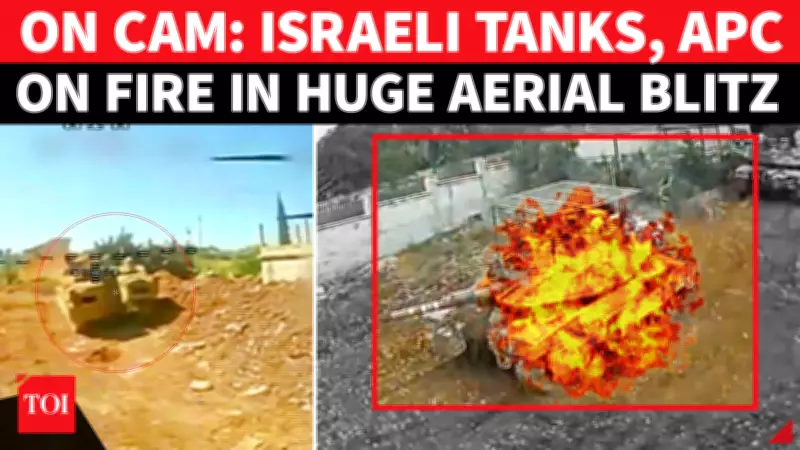
Hezbollah has announced that it launched rocket and first-person view (FPV) drone attacks on Israeli troops stationed in southern Lebanon, citing ceasefire violations and civilian deaths. The group released videos showing drones striking an Israeli Merkava tank, multiple Namer armored personnel carriers (APCs), and a fire-control vehicle. In addition to the battlefield footage, Hezbollah revealed what it claims is an extensive underground tunnel network packed with missiles and launch systems. The footage signals both battlefield precision and strategic depth.
Details of the Attack
The attacks targeted Israeli positions in the border area, with Hezbollah stating that the operations were a response to ongoing violations of the ceasefire agreement and the killing of Lebanese civilians. The use of FPV drones highlights the group's growing capability in drone warfare, allowing for precise strikes on armored vehicles. The videos show direct hits on a Merkava tank, a symbol of Israeli military power, as well as several Namer APCs, which are among the most heavily armored vehicles in the Israeli arsenal.
Revelation of Underground Tunnel Network
Alongside the attack footage, Hezbollah broadcast images of what it describes as a vast network of underground tunnels. The tunnels are said to be equipped with long-range missiles, rocket launchers, and storage facilities, providing the group with a strategic depth that could withstand Israeli airstrikes. This revelation is intended to demonstrate that Hezbollah retains a significant offensive capability despite Israeli efforts to degrade its military infrastructure.

The tunnel network, reportedly located in the Bint Jbeil area, is reminiscent of the tunnels used by Hamas in Gaza. However, Hezbollah's tunnels are believed to be more sophisticated and extensive, with the ability to launch attacks even under heavy bombardment. The group claims that the tunnels are part of a broader strategy to deter Israeli aggression and protect its ability to strike back.
Implications for the Region
The escalation raises fears of a broader conflict between Israel and Hezbollah, which last fought a major war in 2006. Israel has long viewed Hezbollah's missile arsenal as a strategic threat, and the revelation of the tunnel network could prompt preemptive strikes. Meanwhile, Hezbollah's ability to strike Israeli armor with drones suggests a shift in the balance of power on the battlefield.
Analysts warn that the situation could spiral into a full-scale war if both sides continue to escalate. The international community has called for restraint, but with Iran backing Hezbollah and the United States supporting Israel, the risk of a wider regional conflict remains high. The coming days will be critical in determining whether Lebanon and Israel can avoid another devastating war.
Conclusion
Hezbollah's drone blitz and tunnel revelation mark a significant escalation in the ongoing tensions along the Israel-Lebanon border. The group's ability to strike precision targets and maintain a hidden arsenal underscores the challenges facing Israeli defense forces. As the region watches closely, the potential for a new war front looms large.