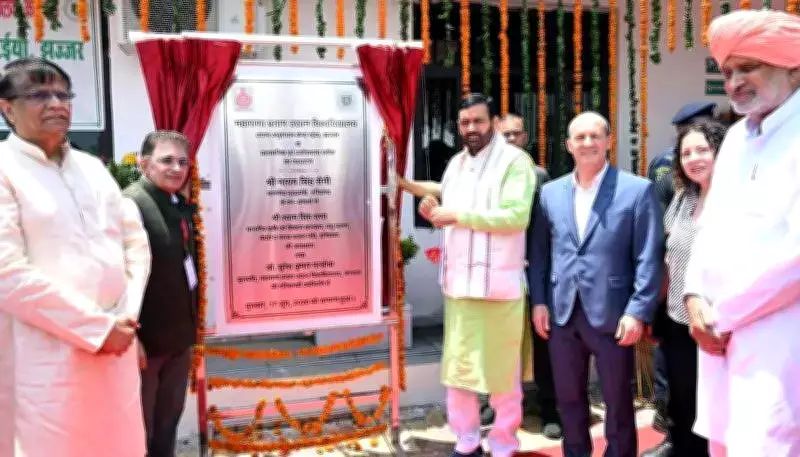
Jhajjar: Haryana Chief Minister Nayab Singh Saini on Wednesday unveiled and dedicated projects worth ₹75.37 crore in Jhajjar district, while announcing a series of fresh infrastructure, healthcare, irrigation, education and rural development initiatives expected to reshape the socio-economic landscape of the Badli Assembly constituency.
The occasion, held at Munimpur village on Maharana Pratap Jayanti, brought together senior political leaders, agricultural experts and international representatives, including Haryana Agriculture Minister Shyam Singh Rana and Israeli Ambassador to India Reuven Azar, underlining the state government's growing emphasis on transforming horticulture into a major engine of rural prosperity.
Inauguration of Key Horticulture Institutions
At the heart of the programme was the inauguration of two landmark institutions aimed at strengthening Haryana's horticulture ecosystem. The CM inaugurated the ₹13.27-crore Horticulture Research Centre at Raiya, developed under Maharana Pratap Horticultural University, Karnal; and the ₹8.50-crore Centre of Excellence for Floriculture and Seed Production Technology at Munimpur. Together, the two facilities represent a major investment in scientific agriculture, advanced research and technology-driven farming.

Addressing the gathering, Saini said Haryana has emerged among the leading states in horticulture development, and that the government is committed to helping farmers move beyond traditional farming towards high-value crops, protected cultivation and technology-led agriculture. He described the Raiya centre as not merely a research institution but a platform connecting scientists, farmers and innovation.
Research Centre Details
Spread across nearly 100 acres, the Raiya Research Centre will focus on developing climate-resilient varieties of fruits, vegetables, flowers and medicinal plants. Research activities will include water conservation, pest and disease management, productivity enhancement, quality improvement and sustainable cultivation practices. Technologies developed at the centre are expected to reduce farming costs, increase yields and improve profitability for farmers.
The Munimpur Centre of Excellence will focus on floriculture and quality seed production while facilitating international collaboration, advanced training programmes and market-oriented cultivation practices. Officials believe the facility will help Haryana farmers access modern cultivation techniques and strengthen the state's position in flower production and export-oriented horticulture.
Other Development Projects
Apart from the horticulture projects, the CM dedicated seven other development works worth ₹53.60 crore to the public. These included the newly constructed Mini Secretariat and residential complex at Badli, developed at a cost of ₹23.41 crore, which is expected to strengthen administrative services and improve public access to government departments. In the education sector, the Chief Minister inaugurated the ₹9.71-crore Government Model Sanskriti Senior Secondary School building at Patoda. Additional educational infrastructure projects included a ₹2.21-crore building at Government Senior Secondary School, Luhari; a ₹2.46-crore building at Government Primary School, Khudan; a ₹1.99-crore building at Government Senior Secondary School, Ukhalchana Kot; and a ₹6.41-crore building at Government Senior Secondary School, Surheti.
Calling agriculture a sunrise sector for entrepreneurship, Saini urged young people to embrace agri-business opportunities driven by drones, artificial intelligence, smart sensors, data analytics, food processing and digital marketplaces.
A ₹7.41-crore drinking water supply project for Saundhi and Nimana villages was also inaugurated, ensuring improved access to safe and adequate drinking water for local residents.
Announcements for Badli Constituency
The event also witnessed a series of major announcements for the Badli constituency. Acting on a memorandum submitted by Om Prakash Dhankhar, the Chief Minister approved a dedicated research centre focusing on horticultural and medicinal crops at Raiya. He also announced the construction of a modern 50-bed hospital in Badli and sanctioned ₹1 crore for a Primary Health Centre in Bupania village.

For sports infrastructure, a model stadium will be developed in Bhindawas village, while ₹5.87 crore will be spent on constructing a new BDPO office building in Machhrauli.
Road infrastructure received a substantial boost, with ₹52 crore earmarked for strengthening and renovating 70 kilometres of roads under the Public Works Department and another ₹15 crore approved for upgrading 25 roads through the Haryana State Agricultural Marketing Board. The government also sanctioned ₹30 crore for converting the northern bypass of Badli into a four-lane corridor.
To strengthen agricultural infrastructure, ₹3 crore will be spent on establishing a crop procurement centre in Badli, while a similar facility will be developed in Patoda once suitable land becomes available.
The Chief Minister further announced ₹1.60 crore for lining drains passing through Kheri Jatt, MP Majra, Badli, Pelpa and Pahasour villages and ₹1.75 crore for laying pipelines up to Drain No. 8 to facilitate floodwater drainage from Girdharpur, Dhakla, Chandol and nearby villages.
Under the Mahagram Scheme, ₹50 crore will be invested in laying sewerage networks in Badli and MP Majra, while ₹13 crore will be spent on strengthening drinking water infrastructure. An additional ₹5 crore grant was announced for rural development projects across the constituency.
Broader Agricultural Vision
Highlighting the government's broader agricultural vision, Saini said Haryana has provided ₹196 crore in assistance to 39,557 farmers under the Bhavantar Bharpai Yojana and continues to promote crop diversification through programmes such as Mera Pani Meri Virasat, micro-irrigation schemes and Farmer Producer Organisations (FPOs). Subsidies ranging from 50 to 85 per cent are being offered for vegetables, mushroom cultivation and protected farming.
The Chief Minister also highlighted Haryana's ₹2,738-crore Sustainable Horticulture Promotion Project, under which 400 horticulture clusters, 500 producer groups, 1,000 rainwater harvesting structures and 65,000 acres under micro-irrigation are planned. The initiative will promote greenhouse cultivation, hydroponics, aeroponics, vertical farming and improved cold-chain infrastructure to reduce post-harvest losses and boost exports.
Agriculture Minister Shyam Singh Rana advocated natural farming and reduced dependence on chemical fertilizers and pesticides, while Om Prakash Dhankhar stressed the need for transforming traditional farming patterns and promoting horticulture around urban centres to enhance farm incomes.
Israeli Ambassador Reuven Azar highlighted the growing India-Israel partnership in agriculture, saying Israeli expertise in water conservation, innovation and precision farming would continue supporting Haryana's horticulture transformation.
The event concluded with the presentation of the prestigious Pushp Ratna and Pushp Samman awards to progressive farmers from across Haryana for their exceptional contribution to floriculture, reinforcing the state government's commitment to recognising agricultural excellence and promoting diversification-led rural prosperity.