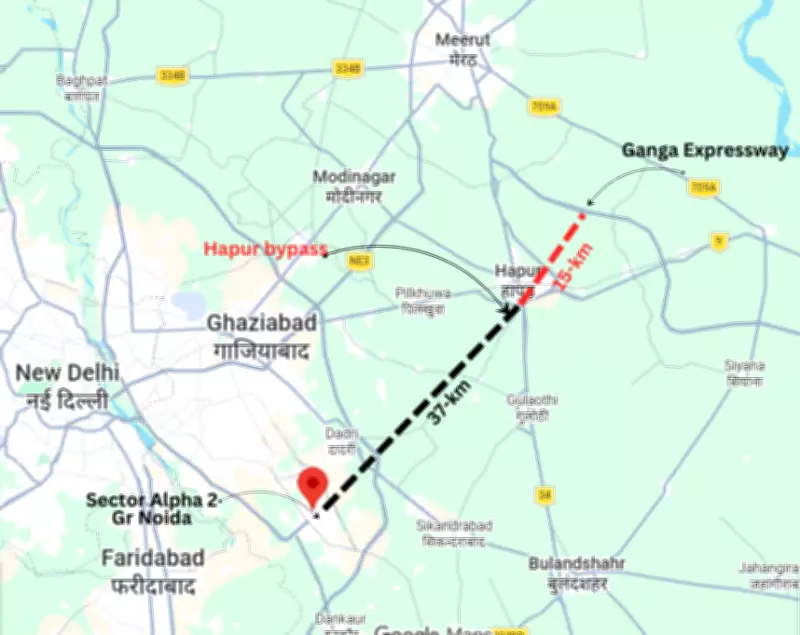
The Greater Noida Industrial Development Authority (GNIDA) board, during its 143rd meeting held on Saturday, approved the extension of an eight-lane road that will connect the city to the Hapur bypass and subsequently to the Ganga Expressway. This corridor is expected to provide a direct high-speed link from the region to the western districts of Uttar Pradesh.
Road Extension Details
The existing 105-metre-wide road currently runs from Sector Alpha 2 to approximately six kilometres near Bodaki village. The approved extension will cover a distance of 37 kilometres to the Hapur bypass, with an additional 15-kilometre link to the Ganga Expressway. Once completed, commuters from Greater Noida are anticipated to reach the expressway within 30 to 45 minutes. This project has been incorporated into the Master Plan 2041.
This will be the third planned expressway connection from the region, joining the proposed DME-Ganga Expressway and Jewar-Ganga Expressway links. Earlier, land acquisition hurdles had stalled the project, but the recent inauguration of the Ganga Expressway by Prime Minister Narendra Modi prompted the Authority to fast-track its development.

GNIDA CEO Ravi Kumar NG stated, "The GNIDA board has approved the extension of the 105-metre-wide road that will connect the Hapur bypass and then the Ganga Expressway." A consultant will be appointed to conduct surveys for route alignment, funding, and land acquisition. The project is expected to take two to three years to complete. The extension will also connect Sector Alpha 2 to NH-91, the Eastern Peripheral Expressway, and New Noida.
Budget and Other Approvals
The board meeting, chaired by Authority chairman and IIDC Deepak Kumar, approved a Rs 6,048 crore budget for the fiscal year 2026-27. Of this, Rs 1,150 crore has been earmarked for land acquisition and Rs 2,176 crore for development works.
Additionally, the board cleared the purchase of two 102-metre hydraulic platforms at an estimated cost of Rs 100 crore to strengthen firefighting capabilities in highrise buildings, in compliance with Chief Minister Yogi Adityanath's directive. Property rates were increased by 3.6% across all categories, aligning with the cost inflation index. Plots of up to 500 square metres will be allotted free of cost to the police and fire departments.
Infrastructure and Traffic Solutions
A six-lane elevated road connecting the logistics hub to the dedicated freight corridor was also approved, aimed at facilitating faster movement of goods without congestion delays. The Indian Institute of Technology Delhi (IIT-Delhi) has been engaged to prepare a comprehensive traffic solution for the Pari Chowk to LG Chowk and Knowledge Park stretch, one of Greater Noida's busiest corridors. IIT-Delhi will design the project, prepare the Request for Proposal (RFP) for contractor selection, and monitor execution.
Housing and Land Allotments
The board approved a one-time settlement scheme for allottees of multi-storey flats ranging from Economically Weaker Section (EWS) to 135 square metres, offering up to 80% relief on outstanding premium and delayed lease deed charges. The scheme will remain open for six months.
Twenty Lower Income Group (LIG) and 10 Middle Income Group (MIG) flats in Sector Omicron 1A were approved for the National Disaster Response Force (NDRF), establishing a disaster response unit in Greater Noida for the first time. The board also allotted 8,000 square metres of land in Techzone to the Meghalaya government for Rs 22.8 crore to construct Meghalaya Bhawan, catering to officials and residents visiting the National Capital Region (NCR) ahead of the upcoming Noida International Airport.