The Science Behind Draco Lizard Gliding
Small reptiles in tropical forests are easy to miss until they move. A rustle against bark, a flash of skin, then something that looks almost impossible at first glance: a lizard lifting away from a tree and crossing open air without falling straight down. Species from the genus Draco have been doing this for millions of years across parts of South and Southeast Asia, gliding between trunks with the help of elongated ribs that support thin membranes along the sides of the body. They are often called flying dragons, although the movement is closer to controlled gliding than powered flight. Interest in them resurfaced recently after renewed attention to the mechanics of their movement and the unusual way their bodies handle aerial control.
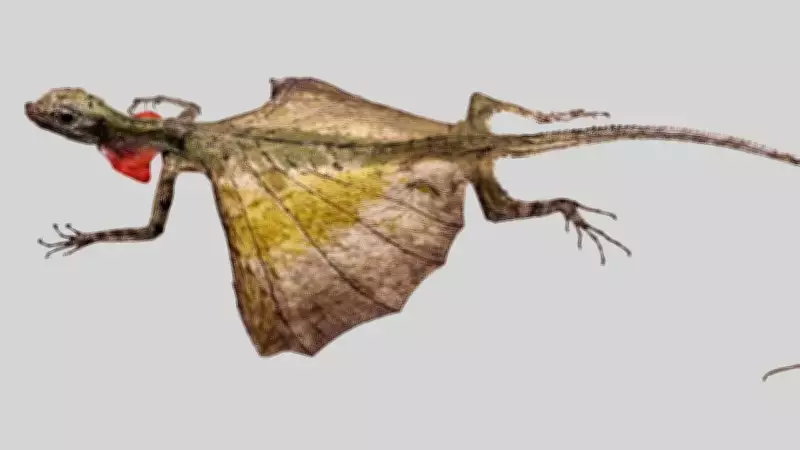
At rest, Draco lizards do not appear dramatically different from many tree-dwelling reptiles. The most unusual structure stays folded tightly against the body. Their extended ribs can spread outward to support broad skin membranes known as patagia, forming temporary wing-like surfaces only when the animal launches itself from a branch. The arrangement has attracted scientific interest for decades because it differs from most other gliding animals. Flying squirrels rely on stretched skin between limbs, while some snakes flatten their bodies during descent. Draco lizards instead use the skeleton itself as the frame.
The control system appears equally important. Research published in the National Library of Medicine, titled "How lizards fly: A novel type of wing in animals," examined how the forelimbs remain connected to the patagium during flight rather than hanging freely. The lizard effectively grips part of its own wing structure while airborne, allowing adjustments in direction and angle during glides. That detail changed earlier assumptions that the membranes simply acted as passive parachutes.

Gliding Behaviour in Tropical Forests
Dense forests create awkward terrain for small reptiles. Moving entirely by climbing can be slow, especially when branches do not connect cleanly overhead. Draco lizards avoid much of that problem by treating gaps between trees as usable space rather than barriers. Glides are usually short but highly controlled, often beginning with a leap downward before the body levels out mid-air. The animal steers toward another trunk, lands headfirst, and immediately circles to the opposite side of the bark. In practice, the movement looks less like flight and more like a rapid transfer system designed specifically for tree habitats.
Their lightweight bodies help. Most species are small enough to remain supported on thinner branches where heavier predators struggle to follow. Colouration also matters. Browns, greys, and muted greens break up the outline of the animal against bark and leaves, especially once the wing membranes fold away again. Some species carry brightly coloured throat flaps beneath the chin, particularly males. These are used less for gliding and more for territorial displays and courtship. In still-forest conditions, the visual signal can travel farther than movement alone.
Why Draco Lizards Evolved Differently
Gliding has evolved many times across animal groups, though often through very different anatomical routes. Mammals, frogs, snakes, and even ants include species capable of controlling descent through the air. Draco lizards remain unusual because the wing support comes directly from elongated ribs rather than modified limbs. That distinction appears repeatedly in evolutionary comparisons. As per a study published in ScienceDirect, titled "Identification key to species of the flying lizard genus Draco Linnaeus," Draco led broader discussions about extinct reptiles that may have used similar membrane-supported structures long before modern gliding animals appeared. Fossilised reptiles such as Coelurosauravus and Icarosaurus also carried extended rib-like supports, though separated from Draco by vast stretches of evolutionary time.

The similarity does not necessarily mean a close relation. It reflects a recurring mechanical solution: expanding surface area without permanently sacrificing climbing ability. Wings built from modified limbs can interfere with life on narrow trunks and branches. Foldable ribs avoid some of those compromises. There is also an energy advantage. Gliding requires less muscular effort than sustained flapping flight. For small reptiles living in warm forests where conserving energy matters, short aerial crossings can suffice without the heavier anatomy of birds or bats.
How Forest Loss Threatens Draco Lizards
The survival of Draco lizards depends heavily on uninterrupted tree cover. Their movement system works best where trunks remain closely spaced and layered at different heights. Once forests become fragmented, the distances between safe landing points increase sharply. Several Draco species continue to live in secondary forests and disturbed habitats, though not always comfortably. Large canopy breaks force animals lower toward the ground, where exposure to predators rises. Logging also changes humidity and temperature within forest interiors, affecting the insects that these lizards feed on.
Much of what is known about Draco behaviour still comes from scattered field observations rather than long-term tracking. Their size makes them difficult to monitor consistently in high canopies. Even so, the existing research has gradually shifted them from being treated as biological curiosities toward examples of highly refined arboreal adaptation. The attention surrounding the so-called flying dragon often centres on appearance first. The mechanics underneath are what continue to interest biologists. A reptile using its ribs as temporary wings sounds improbable until the animal launches itself from a tree and the structure unfolds exactly as intended.