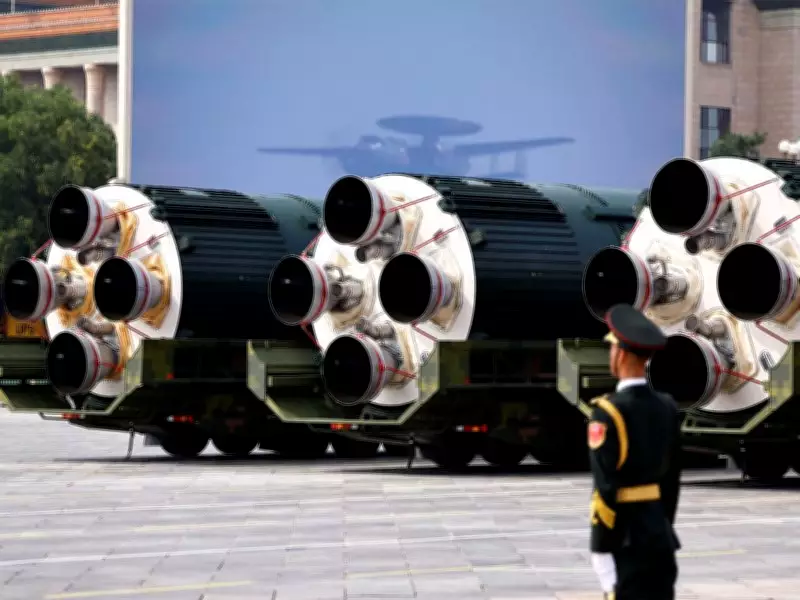
China has ramped up its development and expansion of missile inventory under the People's Liberation Army Rocket Force (PLARF), but the opacity of its intentions is causing alarm across Asia and the world. The discovery of two sprawling new facilities in Xinjiang, likely linked to PLARF nuclear forces, has deepened these concerns.
IISS Report Warns of New Nuclear Arms Race
In its annual Asia-Pacific Regional Security Assessment, the International Institute for Strategic Studies (IISS) stated that the world is on the cusp of a new nuclear-arms race, with the Asia-Pacific at its center. The IISS noted that six of the nine nuclear-armed states have territory or a substantial military presence in the region, and all are modernizing or growing their arsenals, with China's stockpile expanding particularly rapidly.
Pentagon Estimates and Missile Fields
The latest Pentagon report from December 2025 estimated China's nuclear warhead stockpile remained in the low 600s through 2024 but predicted it would surpass 1,000 by 2030, a near fivefold increase from the low 200s in 2020. The PLARF currently has 400 intercontinental ballistic missiles (ICBMs) available from 550 launchers, along with 300 intermediate-range ballistic missiles like the DF-26.

China has built three massive silo fields: Hami in Xinjiang (110 silos), Yumen in Gansu (120 silos), and Yulin in Inner Mongolia (90 silos), totaling 320 silos. The Pentagon believes over 100 silos are loaded with solid-propellant ICBMs, likely for an early warning counterstrike capability. Additionally, the number of DF-5 ICBM silos is expanding from 18 to around 50.
New Mysterious Facilities in Xinjiang
Satellite imagery revealed two new facilities southwest of the Hami silo field, built over the past six years. Each includes over 80 concrete pads for mobile launchers or air defense assets, bunkers, communications facilities, and electronic warfare infrastructure. The sites center on octagon-shaped installations with barracks, storage sheds, fortified bunkers, and weapon storage areas. Airfields and railheads link them to Hami. Military exercises occurred there in April and May 2026.
Alexander Neill of the Pacific Forum think-tank described the infrastructure as being built on a grand scale, covering thousands of square kilometers. Tong Zhao of the Carnegie Endowment suggested the octagonal structures may be linked to command, control, communications, maintenance, and storage for nuclear operations at Hami. A third octagon facility south of Lop Nur is less developed and may serve as a target range.
China's Nuclear Triad Modernization
Chairman Xi Jinping has prioritized a credible nuclear deterrent against the United States, modernizing all legs of the nuclear triad. At the September 2025 Victory Day Parade, the PLA debuted the JL-1 air-launched ballistic missile on H-6N bombers and the JL-3 submarine-launched ballistic missile for Type 094 submarines. China has also improved early-warning capabilities, launching two Huoyan-1 satellites in 2024-25 and deploying ground-based phased-array radars. The Pentagon assessed that China can detect an ICBM launch within 90 seconds and alert a command center in 3-4 minutes, enabling a retaliatory strike before an enemy first strike detonates.
Low-Yield Nuclear Weapons and Dual-Capable Missiles
The Pentagon believes China is pursuing nuclear weapons with yields below 10 kilotons, suitable for limited counterstrikes. The DF-26 intermediate-range missile and the H-6N's air-launched ballistic missile are highly precise and could deliver such warheads. In September 2024, China launched a DF-31 ICBM into the Pacific Ocean for the first time since 1980, traveling 11,000 km to near French Polynesia, likely to practice wartime nuclear deterrence.
Corruption and Readiness Concerns
Despite the buildup, the PLARF has been hit by anti-corruption campaigns, decimating its top leadership. The Pentagon noted this could have short-term effects on readiness but may set the stage for long-term improvements. In February 2026, Major General Yang Guang was removed from his post as Commander of the 64th Base.

Plutonium Production and Regional Implications
China is constructing two CFR-600 sodium-cooled fast breeder reactors at Xiapu in Fujian Province, which will re-establish its ability to produce weapons-grade plutonium. The IISS warned that the United States and its non-nuclear allies Australia, Japan, and South Korea are under pressure to respond to China's and North Korea's growing capabilities. Any crisis over the Taiwan Strait, South China Sea, or Korean Peninsula could raise the risk of nuclear use.
The Pentagon believes Beijing increasingly seeks to use nuclear deterrence to limit adversary involvement in conventional conflicts, adding ambiguity and escalation risks. The IISS concluded that there are few legal arrangements to restrain nuclear rivalries, making the situation increasingly precarious.