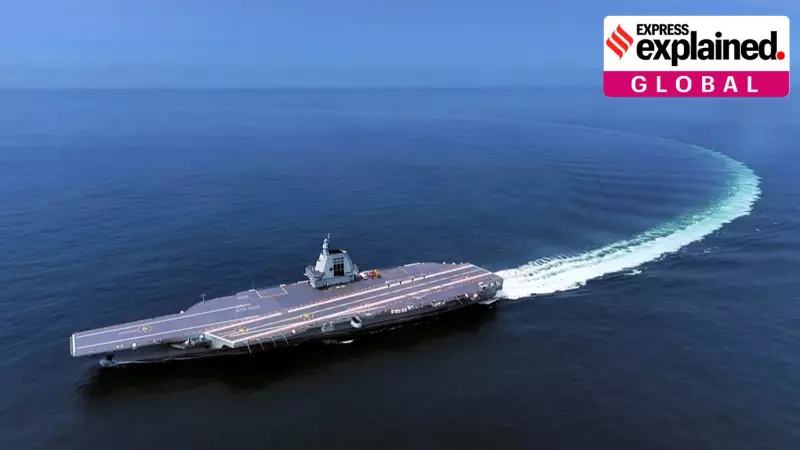
China has officially commissioned its most advanced aircraft carrier to date, the Fujian, marking a significant milestone in Beijing's naval modernization efforts. The induction ceremony took place on Wednesday with President Xi Jinping personally inspecting the vessel in Sanya, Hainan province, according to state media reports.
Revolutionary Launch Technology
The Fujian represents a technological leap for China's People's Liberation Army Navy (PLAN) as it becomes the first Chinese carrier to feature electromagnetic catapults. This advanced launch system distinguishes it from China's two existing carriers, Liaoning and Shandong, which rely on ski-jump ramps similar to those used by Indian aircraft carriers.
Electromagnetic catapult technology enables the Fujian to launch heavier aircraft with larger payloads compared to ramp-based systems. While more complex and expensive to maintain, this system provides greater operational flexibility. The Fujian joins elite company as only the 13th active carrier worldwide using catapult technology and becomes the second vessel after the USS Gerald R Ford to utilize electromagnetic systems specifically.
Chinese state media highlighted that President Xi made the personal decision to adopt electromagnetic catapult technology, underscoring the strategic importance placed on this advancement.
Comparing Global Naval Power
Despite its technological advancements, the Fujian still faces limitations when measured against American carrier capabilities. The United States maintains 11 aircraft carriers, each larger and more capable than any other carrier globally, including China's newest vessel.
According to Carl Schuster, a former US Navy captain with carrier experience, the Fujian's operational capability reaches only about 60% of the Nimitz-class carriers that have been serving for fifty years. This means for every ten aircraft an American carrier can launch, the Fujian can manage approximately six.
The 80,000-tonne Fujian also faces range limitations as it operates on conventional power rather than nuclear propulsion like American carriers and France's Charles de Gaulle. Nevertheless, it represents the closest approximation to American carrier capabilities outside the US fleet and surpasses British carriers in capability due to its catapult system.
Strategic Implications for Taiwan
The naming of China's third aircraft carrier after Fujian province carries significant geopolitical symbolism. The southeastern Chinese province directly faces Taiwan across the strait, and experts anticipate the carrier's eventual deployment in that region.
This development comes amid escalating tensions between Beijing and Taipei, with President Xi repeatedly emphasizing his commitment to "reunification," including through military means if necessary. The historical context dates to 1949 when Kuomintang forces retreated to Taiwan following communist victory on the mainland.
As Collin Koh of Singapore's S Rajaratnam School of International Studies noted to Reuters, while the Fujian represents a potential "game changer" for China, significant testing and refinement of capabilities remain necessary, particularly regarding its role in potential Taiwan conflict scenarios.
The induction of Fujian strengthens China's position as operating the world's largest navy by number of vessels and enhances its blue water capabilities, allowing power projection far beyond its immediate coastal waters.