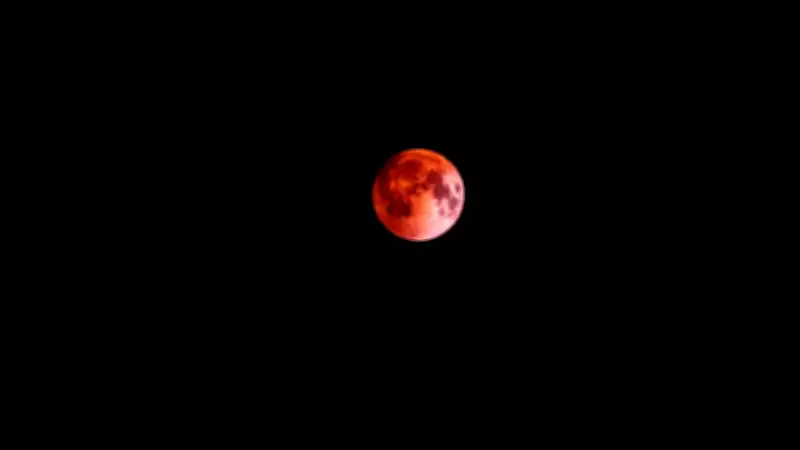
Blood Moon 2026: Total Lunar Eclipse Set for March 3
A total lunar eclipse, famously referred to as a "Blood Moon," is scheduled to grace the night sky on March 3, 2026. During the totality phase, the Moon will adopt a striking reddish hue, creating a celestial spectacle that captivates observers worldwide. This event occurs when the Earth positions itself directly between the Sun and the Moon, obstructing direct sunlight from reaching the lunar surface. The phenomenon, known as a lunar eclipse, allows only filtered light to pass through Earth's atmosphere, resulting in the Moon's dramatic coloration.
Why the Moon Turns Red During a Total Lunar Eclipse
The reddish appearance of the Moon during totality stems from the scattering of sunlight by Earth's atmosphere. As sunlight traverses the atmospheric layers, shorter blue wavelengths are dispersed more effectively, while longer red wavelengths are bent toward the Moon. This process, akin to what causes vibrant sunrises and sunsets, imbues the eclipsed Moon with a coppery or red glow. NASA's detailed descriptions and visualizations of lunar eclipses confirm this scientific explanation, highlighting how atmospheric interactions shape the visual experience.
Visibility and Timing of the March 3 Eclipse
The total lunar eclipse on March 3, 2026, will be the only total eclipse of the year and the last such occurrence until late 2028. It will be visible across extensive regions, including:

- Large parts of Asia and Australia
- North America and select areas of South America
Observers in Europe and Africa may have limited visibility due to local moonrise or moonset times. The eclipse's phases, from the initial penumbral shadow to the deep umbral totality, will unfold at varying local times depending on geographic location. NASA provides eclipse maps and visual tools to assist skywatchers in planning their viewing, detailing how Earth's shadow progresses across the lunar disk.
How to Safely Watch the Total Lunar Eclipse
Unlike solar eclipses, a total lunar eclipse requires no special eye protection and can be enjoyed safely with the naked eye. Viewers can witness the entire event, from the gradual encroachment of Earth's shadow to the peak of totality, without filters. For enhanced details, binoculars or telescopes can reveal intricate surface features on the Moon. To optimize the experience:
- Choose a location with a clear view of the night sky and minimal light pollution.
- Consult local astronomy resources or eclipse apps for precise timing of eclipse phases in your area.
- Arrive at least 30 to 60 minutes before totality to observe the shadow's gradual movement.
Cultural and Astronomical Significance
Total lunar eclipses have long fascinated cultures and astronomy enthusiasts globally. The March 3 event holds particular interest in India, where it coincides with the Holi festival, potentially boosting public engagement in skywatching activities. These eclipses serve as accessible opportunities for educational outreach, allowing people of all ages to explore solar system mechanics and celestial dynamics. Community gatherings and public events often accompany such occurrences, fostering a shared appreciation for astronomical phenomena.
Understanding the Mechanics of a Total Lunar Eclipse
A total lunar eclipse arises when the Sun, Earth, and Moon align precisely, with Earth positioned directly between the other two bodies. This alignment casts Earth's shadow onto the Moon, with the darkest central region, known as the umbra, responsible for the Blood Moon effect. During the eclipse, the Moon first enters the penumbral shadow, experiencing slight dimming, before moving into the umbra, where sunlight is fully blocked except for atmospheric filtering. This configuration ensures visibility wherever the Moon is above the horizon, making it a widely observable event.