

Bhopal's Urban Tigers: A Model of Coexistence
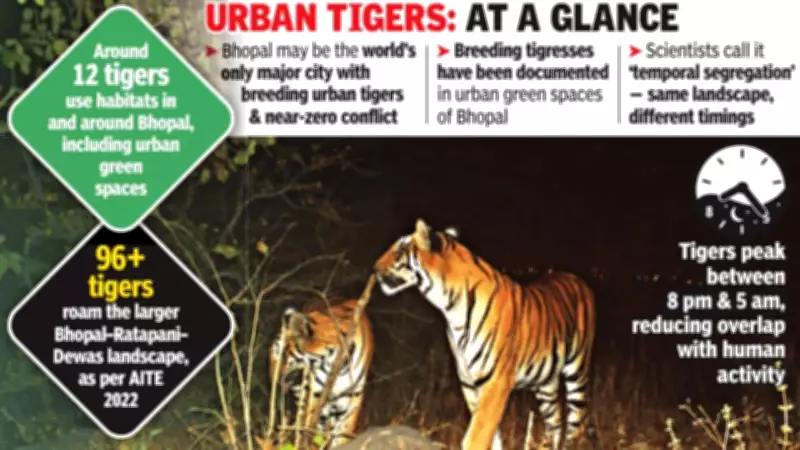
Bhopal, the capital of Madhya Pradesh, presents a remarkable conservation story where tigers have adapted to urban life. Unlike other tiger-bearing cities, Bhopal's big cats move primarily at night, avoiding human activity and breeding within city limits. This phenomenon challenges traditional assumptions about large carnivores and expanding cities.
Nocturnal Adaptation
Madhya Pradesh chief wildlife warden Samita Rajora explained that these tigers have adapted to avoid daylight and move only when the city sleeps. The forest department is launching a radio-collaring project to study their behavior and movement patterns in detail.
Breeding Tigers in Urban Green Spaces
Around 10 to 12 tigers use habitats in and around Bhopal, including green spaces near residential colonies and lakes. Wildlife researcher D P Srivastava noted that breeding tigresses indicate a functional habitat with prey, shelter, and connectivity. The larger Bhopal-Ratapani-Dewas landscape supports over 96 tigers.

Scientific Validation
The study was presented at the Society for Conservation Biology Asia Conference in Kathmandu, Nepal, attended by over 600 researchers from 42 countries. It highlights temporal segregation as a key factor: tigers are most active between 8 pm and 5 am, while humans dominate during the day.
Detailed Research Findings
Between 2019 and 2022, researchers studied 112 grids across Bhopal, Sehore, and Obedullahganj. Camera traps captured 8,641 detections, with 52% human activity, 24% wild prey, 19% domestic animals, and 4.89% carnivores. Scat analysis revealed 12 prey species inside city limits, including nilgai, blackbuck, and wild boar.
Historical Context
Former APCCF L Krishnamurthy noted that tigers have been present in Bhopal for centuries, with trophy hunting during the British and Begum eras. The city's Vindhyan landscape supports prey and co-predators outside protected reserves.
Managing Coexistence
The Bhopal forest division has launched a volunteer program to train villagers in sensitive areas. Retired forest officer R S Bhadoria cautioned that coexistence is a high-risk issue requiring regular monitoring and stakeholder involvement. He emphasized that urban landscapes are dynamic and pose risks to both people and animals.
Conclusion
Bhopal's tiger story offers valuable lessons for conservation in human-dominated landscapes. With continuous research and active management, this unique coexistence can be sustained.






