The story of Bangladesh is a powerful narrative of liberation born from linguistic and cultural identity, yet repeatedly shadowed by political instability. The nation's modern trajectory, bookended by the Decembers of 1971 and 2025, reveals a turbulent cycle where the overthrow of authority seldom guarantees lasting democracy or peace.
The Founding Fault Line: Language and Betrayal
The seeds of Bangladesh's separation from Pakistan were sown just after the 1947 Partition. Muhammad Ali Jinnah, Pakistan's founding father, declared during his 1948 visit to Dhaka that Urdu would be the sole state language. This imposition alienated the Bengali-speaking majority in East Pakistan, who saw it as a direct attack on their cultural identity.
This discontent erupted on February 21, 1952, when police in Dhaka opened fire on student protesters demanding official status for Bengali, killing several. The day, now commemorated as International Mother Language Day, became a cornerstone of Bengali nationalism. Beyond language, East Pakistanis felt economically and politically marginalized, despite contributing significantly to Pakistan's economy through jute exports.

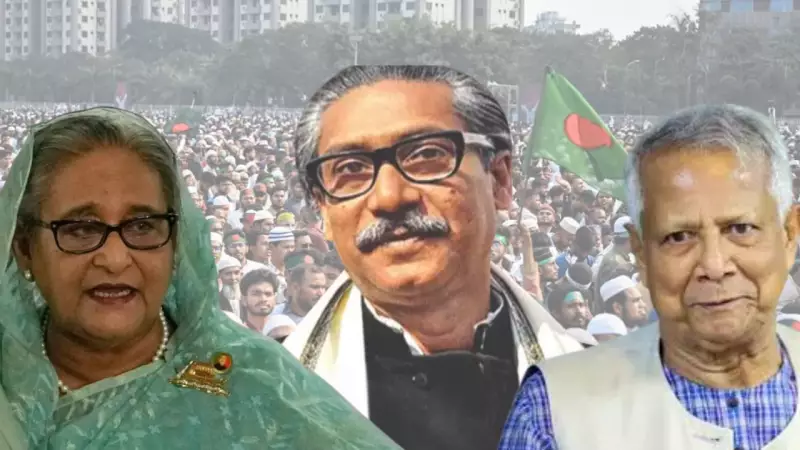
The struggle culminated in the 1970 general elections, where Sheikh Mujibur Rahman's Awami League won a decisive majority. The refusal of West Pakistan's leadership to transfer power led to a brutal military crackdown in March 1971. Following a nine-month war of independence, supported by India, Bangladesh emerged as a sovereign nation on December 16, 1971.
A Turbulent Journey: From Hope to Repeated Upheaval
Independence did not bring stable democracy. Sheikh Mujibur Rahman's early rule was cut short by his assassination on August 15, 1975, plunging the nation into decades of military-backed authoritarian rule under figures like General Ziaur Rahman and General H.M. Ershad.
A mass uprising in 1990 restored civilian rule, leading to a tense, two-party democracy dominated by Sheikh Hasina (Mujib's daughter, leader of the Awami League) and Khaleda Zia (widow of Ziaur Rahman, leader of the Bangladesh Nationalist Party or BNP). However, by the 2020s, critics accused Hasina of authoritarian governance, setting the stage for another rupture.
December 2025: A Nation in Crisis Again
The recent turmoil traces back to the July 2024 uprising that toppled Prime Minister Sheikh Hasina, who fled into exile. An interim government under Muhammad Yunus took charge, but the transition has been marred by violence and uncertainty.
The situation escalated in December 2025 with the assassination of Sharif Osman Hadi, a youth leader and spokesperson for the Inqilab Mancha. His death on December 18 sparked widespread protests, vandalism of media offices like Prothom Alo and Daily Star, and attacks on cultural centers, including the Chhayanaut academy.
A grim pattern of minority-targeted violence has emerged. In separate incidents, Dipu Chandra Das (27) was lynched in Mymensingh on December 17 over blasphemy allegations, and Amrit Mondal (29) was killed in Rajbari on December 26. Rights group Ain o Salish Kendra reported a steep rise in mob violence, with over 180 such deaths in 2025 alone.
The political landscape remains adrift with both major matriarchs absent—Sheikh Hasina in exile and Khaleda Zia critically ill—while the BNP attempts a resurgence under her son, Tarique Rahman, returning from exile.
India's Central Role: From Ally to Point of Tension
India's relationship with Bangladesh is historically profound yet currently strained. While India's military intervention was pivotal in Bangladesh's 1971 liberation, recent events have soured ties. Dhaka has demanded India hand over Sheikh Hasina, while New Delhi is deeply concerned about border violence and attacks on Hindu minorities.

Tensions spilled over in December 2025, with protesters in Dhaka attacking the Indian High Commission. In response, protests erupted in New Delhi and Kolkata, with Indian activists condemning the violence in Bangladesh. The Indian Ministry of External Affairs cited over 2,900 incidents of violence against minorities reported under the interim Yunus government.
The Unresolved Paradox
Bangladesh's story is a paradox. A nation forged in a struggle for linguistic dignity and self-determination continues to grapple with the very demons it sought to escape: political repression, institutional weakness, and communal violence. The fall of Sheikh Hasina's government, much like historical turning points, was greeted as a transformative shift. Yet, the aftermath has been marked by familiar instability, raising fears that the country is drifting back into a dangerous cycle.
As Bangladesh approaches another national election, the core question remains: Can the nation break this cycle and channel its profound history of sacrifice into building a genuinely stable, pluralistic, and democratic future? The echoes between December 1971 and December 2025 serve as a stark reminder of how fragile hard-won freedoms can be.