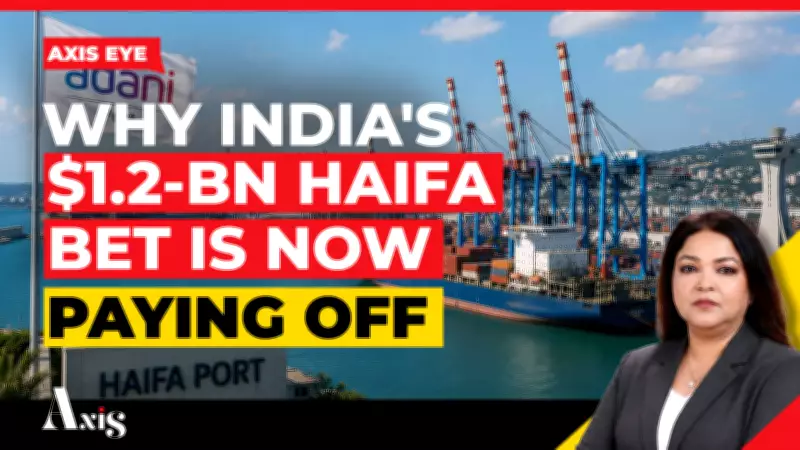
Three years ago, critics questioned why the Adani Group spent nearly $1.2 billion on Israel's Haifa Port. Today, that acquisition looks less like a business deal and more like a geopolitical masterstroke. In this deep dive, we decode why Haifa matters, how it fits into India's long-term strategy, what role it plays in reshaping global trade, and why New Delhi is simultaneously investing in Haifa, Chabahar, and Oman. Is India quietly building the trade architecture of the future?
Why Haifa Port Matters
Haifa Port is Israel's largest and busiest port, serving as a major gateway for trade in the Eastern Mediterranean. Its strategic location makes it a critical node in the India-Middle East-Europe Corridor (IMEC), a proposed trade route that aims to connect India to Europe via the Middle East. By acquiring Haifa Port, India gains a foothold in this corridor, which is seen as a counterbalance to China's Belt and Road Initiative (BRI).
India's Multi-Pronged Strategy
India's investments are not limited to Haifa. New Delhi is also deepening ties with Iran's Chabahar Port and Oman's Duqm Port. This trio of ports forms a strategic triangle that enhances India's maritime presence and trade connectivity. Chabahar provides access to Afghanistan and Central Asia, bypassing Pakistan. Duqm serves as a logistical hub in the Indian Ocean. Together with Haifa, these ports create a network that challenges China's dominance in regional trade.

Geopolitical Implications
The Adani Group's acquisition is a clear signal of India's intent to play a larger role in global trade. It also strengthens India-Israel relations, which have grown significantly in recent years. Moreover, by investing in infrastructure that aligns with the IMEC, India is positioning itself as a key player in the evolving global supply chain, reducing dependence on routes controlled by China.
Critics initially dismissed the Haifa Port deal as overpriced, but it is now viewed as a visionary move. As global trade dynamics shift, India's strategic bets on ports like Haifa are likely to pay off, offering both economic returns and geopolitical leverage.