India is one of the world's most important countries for primate diversity. From the rainforests of the Western Ghats to the floodplains of the Brahmaputra and the temperate forests of the eastern Himalayas, the country is home to an extraordinary variety of monkeys and langurs adapted to vastly different habitats. Some are widespread and frequently encountered by travellers on safari, while others survive only in fragmented forests and are considered among the rarest primates in Asia.
For wildlife travellers, primate watching offers a deeper understanding of India's ecosystems. Langurs often act as sentinels in tiger habitats, warning deer and other animals of approaching predators, while macaques demonstrate remarkable intelligence and social complexity. Observing these species in the wild, rather than in urban settings, reveals behaviours ranging from grooming rituals and infant care to sophisticated foraging strategies.
Here are 10 monkey species found in India and the forests where travellers have the best chance of encountering them.

1. Hanuman Langur
Arguably India's most recognisable primate, the Hanuman langur belongs to a complex of gray langur species distributed across much of the subcontinent. Revered in Hindu mythology due to their association with Lord Hanuman, these long-limbed, black-faced monkeys are primarily leaf-eaters but also consume fruits, flowers and seeds. Their elevated vantage points make them particularly alert to predators, and their alarm calls are often used by wildlife guides to locate tigers and leopards. Where to spot them? Try Ranthambore National Park in Rajasthan, Bandhavgarh National Park in Madhya Pradesh, and Jim Corbett National Park in Uttarakhand.
2. Arunachal Macaque
One of the most remarkable wildlife discoveries in recent Indian history, the Arunachal macaque was formally described only in 2005. Adapted to high-altitude forests and rugged mountain terrain, it possesses a dark face and thick coat suited to cooler climates. Its relatively recent scientific recognition highlights how much remains to be learned about India's biodiversity. Chances of seeing them in the wild is still little but not impossible in Eaglenest Wildlife Sanctuary and Sessa Orchid Sanctuary in Arunachal Pradesh.
3. Stump-tailed Macaque
Among India's most elusive primates, the stump-tailed macaque is named for its short, almost inconspicuous tail. It has a robust build, reddish face and prefers undisturbed evergreen forests. Unlike more conspicuous macaque species, it tends to avoid human activity, making sightings particularly rewarding for serious wildlife enthusiasts. Namdapha National Park in Arunachal Pradesh, Dampa Tiger Reserve in Mizoram, and Balpakram National Park in Meghalaya are the best places to spot them in the wild – considering you are lucky enough.
4. Bonnet Macaque
Endemic to southern India, the bonnet macaque derives its name from the distinctive bonnet-like arrangement of hair radiating from the crown of its head. Highly adaptable and intensely social, these macaques live in multi-generational troops with complex dominance hierarchies. While many populations are accustomed to human presence, observing them in forest habitats provides insight into their natural feeding and grooming behaviours. Best places to spot them are Bandipur National Park and Nagarhole National Park in Karnataka, and Mudumalai National Park in Tamil Nadu.
5. Rhesus Macaque
Among the most widespread primates in Asia, the rhesus macaque occupies habitats ranging from Himalayan foothills and deciduous forests to agricultural landscapes. They are remarkably intelligent and opportunistic, capable of exploiting diverse food sources. Despite their familiarity in towns and temple complexes, forest populations display more cautious and natural behaviour. They are easily spotted in Rajaji National Park in Uttarakhand, Dudhwa National Park in Uttar Pradesh, and Valmiki Tiger Reserve in Bihar.

6. Lion-tailed Macaque
The lion-tailed macaque is one of India's most iconic endemic mammals and among the world's most threatened primates. Restricted to the evergreen rainforests of the Western Ghats, it is instantly recognisable by its silver-white mane and tufted tail. These canopy specialists spend most of their lives high in the trees, feeding on fruits, insects and small vertebrates. Silent Valley National Park in Kerala, Anamalai Tiger Reserve in Tamil Nadu, and Kudremukh National Park in Karnataka are some of the best places to spot them in the wild.
7. Nilgiri Langur
Often overshadowed by its more famous Western Ghats counterparts, the Nilgiri langur is a striking species characterised by glossy black fur and a golden-brown head. Unlike many gray langurs of northern India, Nilgiri langurs are strongly associated with moist evergreen and shola forests. Their loud calls frequently echo through the hills before they become visible. Where to spot them? Try Eravikulam National Park and Parambikulam Tiger Reserve in Kerala, and Kalakkad Mundanthurai Tiger Reserve in Tamil Nadu.
8. Golden Langur
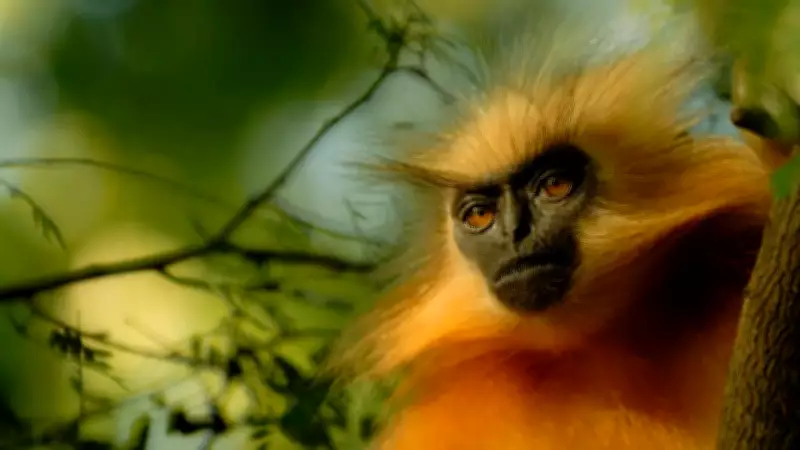
Few primates are as visually spectacular as the golden langur. Its creamy-gold coat varies in intensity depending on the season and age of the individual. The species is found only in a narrow region between the Brahmaputra River and the foothills of Bhutan, making it one of India's most range-restricted primates. Habitat loss has resulted in increasingly fragmented populations. Manas National Park and Chakrashila Wildlife Sanctuary in Assam are some of the best places to spot them in the wild.
9. Capped Langur
Named after the dark patch of hair resembling a cap on its head, the capped langur inhabits subtropical and tropical forests of northeastern India. It is an agile arboreal species that moves gracefully through the canopy in small family groups. Their diet consists largely of leaves, fruits and flowers. Namdapha National Park and Pakke Tiger Reserve in Arunachal Pradesh, and Nameri National Park in Assam are some of the best places to see them in the wild.
10. Phayre's Langur
Also known as the spectacled langur due to the pale rings around its eyes, Phayre's langur is among India's lesser-known primates. The species inhabits dense evergreen forests in the northeast and spends most of its time in the upper canopy. It is considered threatened because of habitat degradation and hunting pressures across parts of its range. Sipahijala Wildlife Sanctuary in Tripura and Dampa Tiger Reserve in Mizoram are places where there are chances to spot these magnificent species.