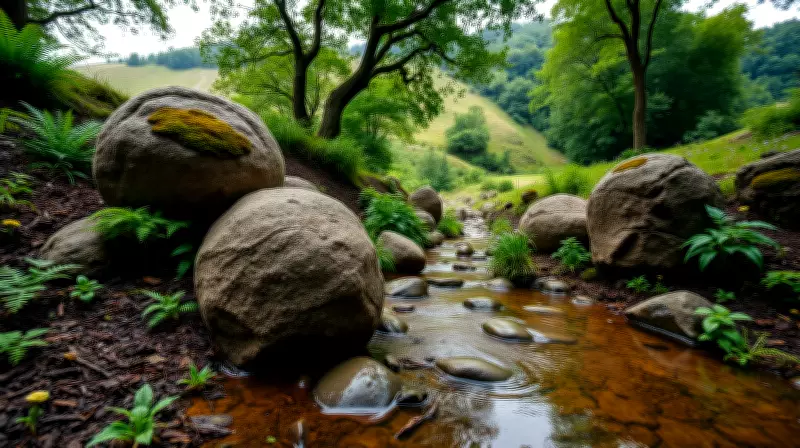
If you live in Ohio and have ever spotted a strangely round, heavy rock in your garden or along a creek bed, one that looks too smooth and too symmetrical to belong there, you are not imagining things. Residents across the state, particularly around Columbus, have been puzzling over these sphere-like formations for years, occasionally mistaking them for cannonballs or man-made objects. Geologists have a name for them: concretions. And far from being modern oddities, these rocks are windows into a time, roughly 360 million years ago, when the land we now call Ohio sat beneath a warm, teeming prehistoric ocean long before the age of dinosaurs, let alone the age of people.
What are concretions and why are they found all across Ohio
Concretions are naturally occurring stone formations, often spherical, that form when minerals precipitate around a central object, such as a fossil or other organic material. According to Erika Danielsen, a geologist with the Ohio Department of Natural Resources, concretions are most commonly found in the shale deposits of Ohio. To understand concretions, it helps first to understand the shale they come from. As Danielsen explains, shale begins as mud deposited at the bottom of an ancient ocean. Over time, that mud gets buried under more and more sediment, compressing it and causing it to lose water until it hardens into the layered rock we recognise today. This process happened during the Devonian period, roughly 360 million years ago a time geologists sometimes call the "age of fish," when Ohio was submerged under a shallow inland sea teeming with marine life.
How a dead fish millions of years ago created the rock in your garden
The process of concretion formation is, at its heart, a story about decomposition. It starts when organic matter, like a jawbone from a large fish such as the Dunkleosteus a predator from the same period, sinks into the mud at the bottom of the ocean. Bacteria and microorganisms begin breaking down the organic matter, which changes the chemistry in the surrounding mud and water. That chemical shift allows carbonate minerals to start precipitating in that zone. Think of it as a mineral bubble growing slowly outward from the decaying organic material at the centre. The carbonate minerals that fill this zone are similar in composition to limestone and dolomite. Over millions of years, as the surrounding clay mud compresses into shale, these mineral-rich zones harden into the rounded, dense formations that eventually erode out of cliffs and creek beds and occasionally end up in someone's backyard in Columbus.

The size range of Ohio concretions and where to find them
One of the best places to see concretions up close is Shale Hollow Park, located about five miles north of Columbus. The creek running through the park cuts between tall cliffs of red, grey, and brown shale, with concretions of various sizes visible both embedded in the cliff face and sitting along the creek bed. Danielsen noted that concretions in the Ohio Shale can range anywhere from centimetre size up to roughly nine feet in diameter. The ones most people find in their gardens tend to be smaller, roughly grapefruit-sized, because they have been broken loose from shale beds by erosion, carried by water, and scattered across the landscape over thousands of years.
What's actually inside a concretion and the fossil question
One of the most common questions people have about concretions is whether there is a fossil hiding inside. The honest answer is: possibly, but probably not. Because the formation process begins around an organic nucleus, there is a chance that what started the whole process a bone fragment, a shell, a jawbone, is still preserved within the rock. Danielsen noted that there are probably more concretions without fossils at their centre than with them, and you generally cannot tell from the outside. That said, palaeontologists have indeed found remarkable specimens within Ohio concretions, including well-preserved remains of Dunkleosteus the enormous armoured fish that patrolled the Devonian sea. The Ohio Department of Natural Resources documents concretions as a key part of the state's geological record, studied for the clues they hold about ocean chemistry and mineral conditions during the Devonian age.

Why Ohio has so many of these ancient geological formations
Ohio sits atop an exceptionally rich record of Palaeozoic-era geology. During the Palaeozoic Era, shallow inland seas covered much of the state, laying down extensive marine limestone and shale deposits. The glacial activity of the Pleistocene ice age, which ended roughly 15,000 years ago, then scoured and shifted much of this ancient rock across the landscape which is why concretions and other geological remnants turn up far from their original formation sites, including in suburban gardens. At Flint Ridge in Licking County, for instance, beds of flint nodules formed when silica replaced calcium carbonate in limestone were originally buried under sea-bottom sediments and eventually exposed by glacial scouring at the end of the ice ages. The same glacial forces that spread flint across eastern Ohio also redistributed concretions more broadly across the state's central and northern regions.
Why these rocks still matter to science and why you should pay attention
Geologists study concretions to find clues about ocean chemistry and mineral deposits in the Devonian period, though there are still more questions around concretions than clear answers. Each one is a time capsule, chemically sealed at the moment of its formation, which means the minerals and sometimes the organic material inside are preserved in conditions that reflect the ancient ocean environment rather than anything that came after. For most people who stumble across one in a garden or along a hiking trail, a concretion may look like an oddity a rock too round to be natural, too heavy to ignore. But it carries within it a record of an ocean that vanished 360 million years ago, a fish that no longer exists, and a geological process so slow it makes human history look like a blink. Ohio, it turns out, is quietly one of the most geologically storied states in America and some of that story is sitting right in your backyard.