New Bengal Tiger Photographed in Buxa, Could Be First-Time Visitor from Bhutan
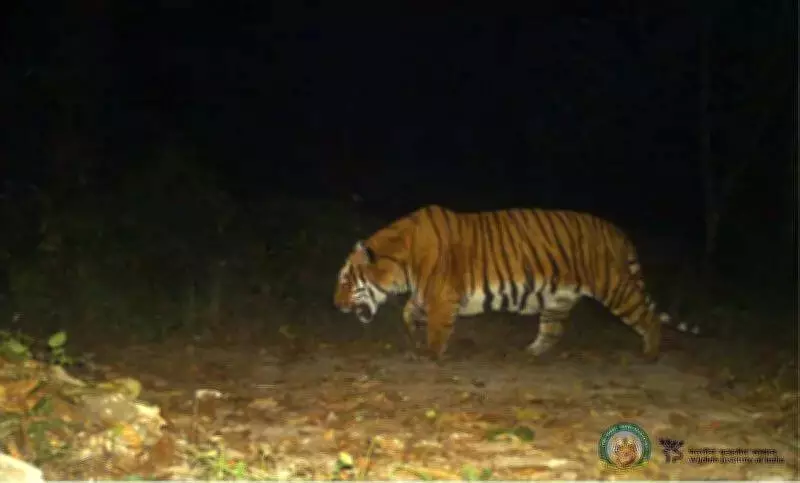
A new Bengal tiger has been photographed in the Buxa Tiger Reserve in West Bengal, marking its first documented appearance in the northeast tiger landscape. This significant discovery has sparked interest among wildlife experts and forest officials, who are now working to identify the origins of this majestic big cat.
First-Time Photograph and Database Analysis
The tiger was recently captured on camera in Buxa, and it will be counted under the All-India Tiger Estimation (AITE) exercise. Officials have indicated that it may also receive an identification number within the North Bengal park system. Chief Wildlife Warden Sandip Sundriyal confirmed that the photo does not match any existing records in the National Repository of Camera Trap Photographs of Tigers (NRCTPT).
Wildlife Institute of India compared this tiger individual with the North East Hills & Brahmaputra Flood Plains NRCTPT database and no match was found, said Sundriyal. This suggests that the tiger has not been photographed before in this region, adding to the mystery of its origins.

Possible Origins from Bhutan or Assam
Foresters and experts are exploring two primary theories about where this tiger came from. One possibility is that it was never previously photographed in Assam's Manas Tiger Reserve. The other, more intriguing theory, is that it has migrated from Bhutan's Royal Manas landscape, which is connected to Buxa through the Phibsoo Wildlife Sanctuary.
Conservationist Biswapriya Rahut emphasized the importance of treating tigers in these corridors as a separate block. For a tiger traversing this corridor, it will be easier to enter Buxa through Bhutan as the corridor from Assam's Manas is fragmented, he explained. The route through Bhutan's Phibsoo will offer it a much better green cover and help it enter Buxa from its northern boundary. Rahut advocates for not counting these tigers as belonging solely to Manas, Buxa, or Bhutan, but rather as part of a interconnected population.
Challenges and Conservation Efforts
A senior official from the National Tiger Conservation Authority (NTCA) highlighted the challenges of camera-trapping in the moist deciduous forests of the Northeast Hills. It's highly possible that the tiger was not earlier clicked in Assam's Manas, the official noted. The focus now is on the fact that the big cat has been photographed for the first time in Buxa.
The official also mentioned ongoing habitat augmentation efforts in Buxa, including the relocation of some villages. Once these are achieved, we believe Buxa will also have its resident tiger population, he added, expressing optimism for the future of tiger conservation in the area.
Tiger Population Trends and Connectivity
According to the AITE report from 2022, tigers were photo-captured for the first time in Buxa, Neora Valley, and Mahananda in North Bengal. The report estimated a tiger population of 61 in the Manas-Buxa-Neora-Mahananda block, showing a steady increase from previous cycles.
This block is connected to Bhutan's tiger population, which was estimated at 91 tigers, with 60 adult females and a density of 2-3 tigers per 100 square kilometers in Royal Manas. The report added that if corridors maintain connectivity, the tiger population in Manas could expand westward, reaching Buxa via Raimona and the Ripu-Chirang Elephant Reserve. This forms a sub-block, Buxa-Jaldapara-Neora-Mahananda, which links to the larger Manas block through Bhutan corridors.
The discovery of this new tiger in Buxa underscores the importance of cross-border conservation efforts and the dynamic nature of tiger populations in the region. As officials continue to monitor and study this individual, it highlights the ongoing success and challenges of wildlife preservation in India's northeastern landscapes.