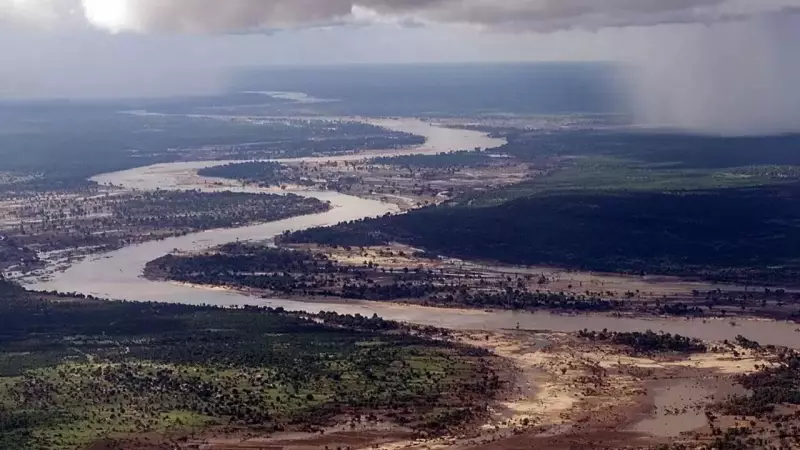
The Limpopo River stands as one of Africa's most remarkable geographical wonders, carving an extraordinary path through southern Africa that defies conventional river patterns. This majestic water body holds the rare distinction of being one of the few rivers globally that crosses the Tropic of Capricorn not once, but twice during its extensive journey to the Indian Ocean.
The Unique Geography of Limpopo River
Flowing across four southern African nations - South Africa, Botswana, Zimbabwe, and Mozambique - the Limpopo River creates a dramatic S-shaped course that fascinates geographers and nature enthusiasts alike. The river originates as the Krokodil (Crocodile) River in South Africa's Witwatersrand region and travels approximately 1,750 kilometers (1,087 miles) before emptying into the Indian Ocean near Xai-Xai in Mozambique.
What makes this river particularly special is its relationship with the Tropic of Capricorn, an imaginary line located at approximately 23.5° south of the Equator. This line marks the southernmost point where the sun can be directly overhead during the December solstice. The Limpopo's winding path causes it to intersect this significant geographical marker twice, creating a natural phenomenon that few rivers worldwide can claim.

Historical Significance and Ecological Importance
According to the Limpopo Watercourse Commission (LIMCOM), the official body coordinating water-resource governance for the Limpopo Basin, this river represents one of southern Africa's major transboundary river systems. The river basin spans an impressive 415,000 square kilometers, roughly equivalent to the size of Sweden, supporting diverse ecosystems and human settlements along its banks.
The Limpopo serves as a natural border for about 640 kilometers of its length, separating South Africa from Botswana and Zimbabwe. These borders have historically influenced trade, settlement patterns, and cultural exchange throughout the region. The river's historical significance extends to the Mapungubwe area near its upper reaches, which was part of a thriving trading kingdom around AD 1200.
Archaeological evidence reveals that communities along the river engaged in extensive trade, agriculture, and cultural exchange, establishing the Limpopo as an artery of human civilization long before modern borders were established.
Seasonal Patterns and Wildlife Habitat
The Limpopo River exhibits fascinating seasonal behavior that defines its ecological character. During the summer rainy season, the river swells and floods, nourishing fertile floodplains and providing vital water for agriculture. In contrast, the river slows and significantly dries during winter months, leaving isolated pools that sustain wildlife in the region's iconic reserves, including the world-renowned Kruger National Park.
The river's flow demonstrates extreme variability - in dry years, the upper river may flow for just 40 days or less, while heavy rains can cause catastrophic floods like those triggered by Cyclone Eline in February 2000. The river carries substantial sediment, giving it a characteristically silty, sluggish appearance for much of the year. Only near its mouth, after the confluence with the Olifants River, does it become permanently navigable.
The Limpopo supports an array of wildlife, functioning as a critical lifeline for the region's biodiversity. Its waters and floodplains sustain numerous fish species, diverse bird populations, and various mammals, while surrounding wetlands provide crucial habitat for endangered species. The river's seasonal rhythms profoundly shape the lives of both human communities and wildlife, demonstrating the intricate interconnectedness of natural systems and human activity in southern Africa.
Today, the Limpopo remains the second-largest African river draining into the Indian Ocean, after the Zambezi, and continues to inspire explorers, scientists, and travelers with its unique geographical features, historical importance, and ecological significance.