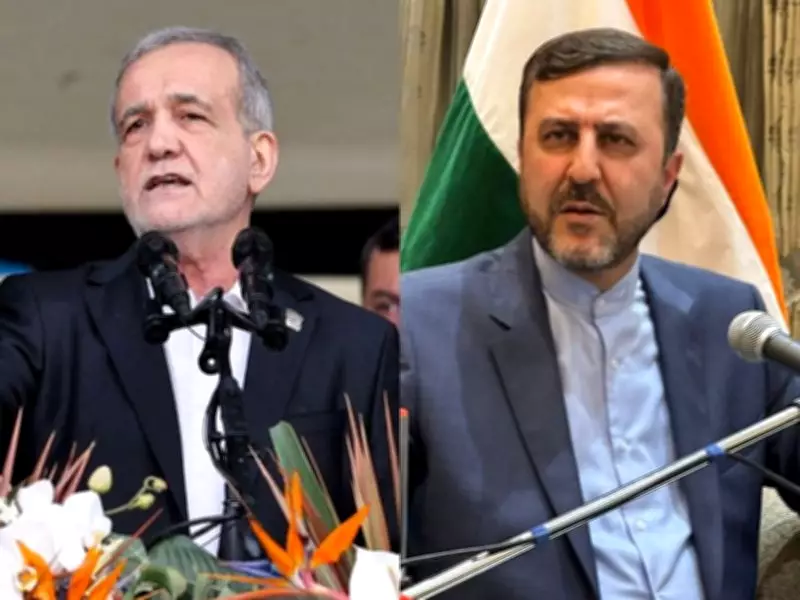
Pezeshkian Calls for Full Commitment to Iran-US MoU
Iranian President Masoud Pezeshkian on Tuesday emphasized that the effectiveness of the recently concluded US-Iran Memorandum of Understanding (MoU) hinges on strict adherence to agreed obligations and their precise implementation. In a post on X, Pezeshkian stated, "The effectiveness of the talks depends on full commitment to the agreed obligations and their precise implementation. Progress on this path will be measured by practical adherence to accepted responsibilities. Statements outside the agreed text do not help advance the negotiations."
Context: Trump-Netanyahu Remarks and Regional Tensions
Pezeshkian's comments came hours after US President Donald Trump said he would resolve issues with Israeli Prime Minister Benjamin Netanyahu quickly, following Netanyahu's refusal to withdraw forces from southern Lebanon despite the ongoing US-Iran peace talks. Netanyahu asserted that the Israeli Defence Forces (IDF) would remain in the security zone in southern Lebanon, vowing that Iran would never obtain a nuclear weapon under his leadership.
Gharibabadi Outlines Next Phase of Negotiations
Iranian Deputy Foreign Minister Kazem Gharibabadi provided details on the upcoming negotiations, which will include high-level participants: Iran's Parliament Speaker Mohammad Bagher Ghalibaf, Foreign Minister Abbas Araghchi, US Vice President JD Vance, Pakistani Prime Minister Shehbaz Sharif, and Qatari Prime Minister Mohammed bin Abdulrahman Al Thani. Gharibabadi announced the formation of four working groups focusing on ending sanctions, nuclear issues, reconstruction and economic development, and monitoring and implementation.

Regional Security and Financial Measures
Regarding Lebanon, Gharibabadi stated that an agreement was reached to establish a conflict prevention unit in Lebanon involving member countries, Pakistan, and Qatar. On financial aspects, he confirmed that the release of USD 12 billion—split into two amounts of USD 6 billion each—would immediately enter the implementation phase.
MoU Formalization and Working Groups
The talks in Switzerland concluded on June 21, with the joint statement formalizing the MoU issued on June 22. The agreement is expected to guide future negotiations, with implementation overseen by the newly established working groups.
Ghalibaf: Iran to Administer Strait of Hormuz
Iran's Parliament Speaker Mohammad Bagher Ghalibaf stated that the Strait of Hormuz will not return to its pre-war operational status and that Iran will manage the strategic waterway under its own arrangements while adhering to international regulations. Speaking upon his return from Switzerland, Ghalibaf said, "Everyone should know that the administration of the Strait of Hormuz will never go back to the way it was before the war. Of course, international regulations will be observed, but Iran will administer the Strait of Hormuz." He also claimed that Iran demonstrated its negotiating leverage during the talks in Switzerland.